
Class B theory course · chapter 7 of 22
Signs, signals and police directions
The sign groups and the logic behind them, priority, give-way and prohibition signs, traffic lights and the order of precedence between police, lights and signs.
The chapter in numbers
- Lessons
- 3about 12 minutes of reading
- Drawings
- 11diagrams and photographs made for the lessons they sit in
- Exam tips
- 5passages that say what the test tends to ask here
- Terms
- 4words explained where they are first used
Why this chapter
Signs are the language the road speaks – and the test expects you to read it fluently. This chapter covers the sign groups and what shape and colour tell you, the light signals and what they require, and police hand signals, which override everything else. Learn the system and you will not have to memorise every single sign.
Written against
The lessons are written against these sources, and the explanations cite them.
- Skiltforskriften
- vegvesen.no – trafikkskilt
- trafikkreglene
- Trafikkreglene
- vegvesen.no
What the test asks
The practice questions for this chapter belong to 2 of the seven official themes of the theory test.
- Right of way256 practice questions · 9 of 45 in our mock exam
- Signs & road markings283 practice questions · 9 of 45 in our mock exam
The mock-exam split is our own – Statens vegvesen publishes none.
The sign groups in this chapter
Each group has its own page with every sign, its picture and its meaning – free to read.
The lessons, in order
- 1 Sign groups – how they are structuredThe main sign groups, shapes and colours that allow you to read a sign before you have time to read the text. 4 min
- 2 Priority, give-way and prohibition signsThe signs that control who drives first, and what you are not allowed to do. 3 min
- 3 Traffic lights, signals and police signalsLight signals, signals at level crossings, and why police signals take precedence over everything else. 5 min
The lessons are part of full access – 149 kr for a week, 199 kr for a month. Chapter 1 is free, so you can see how the course is written first.
All 22 chapters
- 01Introduction
- 02The human in traffic
- 03The car – construction and systems
- 04Checks and maintenance
- 05The road and the traffic environment
- 06The traffic rules and basic duties
- 07Signs, signals and police directions
- 08Giving way and right of way
- 09Observation and communication
- 10Positioning and lane use
- 11Speed, distance and braking distance
- 12Junctions and roundabouts
- 13Overtaking and meeting
- 14Different roads and surroundings
- 15Light and road-surface conditions
- 16Other road users
- 17Stopping and parking
- 18Eco-friendly driving
- 19Load and trailer
- 20The driver's responsibility
- 21At a traffic accident
- 22Risk and attitudes
Read the whole chapter
Full access opens all 22 chapters, mock exams with new questions every time and the sign drill – 149 kr for a week, 199 kr for a month, no automatic renewal.
Sign groups – how they are structured
Road signs are a common language. Shape and colour are chosen so that you understand the message quickly, often before you can read the details. When you know the system behind the groups, you do not need to memorise every single sign – you read them.
A sign must be understood at distance, at speed and in poor weather. That is why the shape comes first, the colour next, and the symbol last. In the test, read signs the same way: group, main message, then details and supplementary signs.
The shape and colour tell you the sign group before you read the symbol.
Main groups
| Group | Shape and colour | Purpose |
|---|---|---|
| Warning signs | Triangle, red border, yellow/white background | Warns of danger ahead of you. |
| Give-way and priority signs | Their own shapes: triangle point down (give way), octagon (stop), yellow diamond (priority road) | Regulate who gives way and who has priority. |
| Prohibition signs | Round, red border | Prohibits or limits something from this point. |
| Mandatory signs | Round, blue background | Requires a particular driving direction or action. |
| Information signs | Rectangular, blue or green | Gives information, for example about a motorway or pedestrian crossing. |
| Service signs / direction signing | Rectangular | Shows directions and services. |
| Supplementary sign | White rectangle below the sign | Clarifies or limits the sign above. |
| If you only have time to see ... | Think first |
|---|---|
| Triangle with red border | Hazard ahead: reduce pace and look for what may happen. |
| Round sign with red border | Something is prohibited or limited from this point. |
| Round blue sign | You must follow a particular direction or action. |
| Rectangular blue/green sign | Information or direction signing; it may still require action. |
| White plate below | The main sign is specified: read this before you conclude. |
A sign normally stands on the right-hand side of the road, facing the road users it applies to, and takes effect from the point where it stands. The stretch behind you is no longer governed by the sign – it is the road ahead that counts.
The rule starts at the signpost – not where you first spotted the sign.
Supplementary signs change the meaning
A supplementary sign can limit the main sign – for example to a particular stretch, time period or vehicle group. If you overlook the supplementary sign, you may misunderstand the whole message.
The same main sign with three different plates below: time, vehicle group and extent give three different rules.
Sign group: A family of signs with a shared shape, colour and function, for example warning signs, prohibition signs, mandatory signs and information signs.
Supplementary sign: An additional sign, usually a white rectangle below the main sign, that clarifies or limits when and for whom the main sign applies.
Priority, give-way and prohibition signs
Some signs directly affect the interaction at junctions and decide who must wait. Others prohibit an action completely. These are among the most important to know, because they often override the main rules.
Priority means that others should normally give way to you, but it is not a shield. You must still read their speed, visibility, grip and whether someone may have missed the sign. The safe answer is often to give up a little time to keep safety.
Duty to give way and priority
| Sign | Meaning |
|---|---|
| Give way (inverted triangle) | You have a duty to give way to crossing traffic. Reduce speed and be ready to stop. |
| Stop | You must come to a complete stop at the stop line, regardless of whether it is clear, and then give way. |
| Priority road | You have priority on the stretch. Even so, be prepared for others to make mistakes. |
| End of priority road | Priority ends – other rules may now apply again. |
Downward triangle, octagon and yellow diamond: the shape alone says who must wait.
| Situation | What you do |
|---|---|
| Give way, good visibility | Adapt speed early and choose a gap without forcing others to brake or swerve. |
| Give way, poor visibility | Creep forward and be ready for a complete stop before entering. |
| Stop | Stop completely first, then observe; a rolling stop is not enough. |
| Priority road | Keep flow, but cover the brake at side roads and signs of mistakes by others. |
Prohibition signs
- No entry, no overtaking, no stopping and no parking are among the most common.
- Speed limit signs set the highest permitted speed on the stretch.
- A prohibition applies from the sign until it is ended, a new speed limit is set, or a junction changes the situation.
The prohibition starts at the sign and lasts to the junction – no further.
Prohibition signs should be read literally, but also practically. Ask: what is prohibited, for whom, where does it start, and where does it end? A no-stopping prohibition is stricter than a no-parking prohibition; no stopping normally means you cannot stop for loading or unloading either.
One slash bans parking; a cross bans even a brief stop to load.
Priority road: A road where you have priority at the junctions. Shown with its own sign, and ended by the 'end of priority road' sign.
Traffic lights, signals and police signals
Signals control traffic where a clearer instruction is needed than signs can give. The most important are ordinary traffic lights, but you must also know signals at level crossings and – most importantly – police signals.
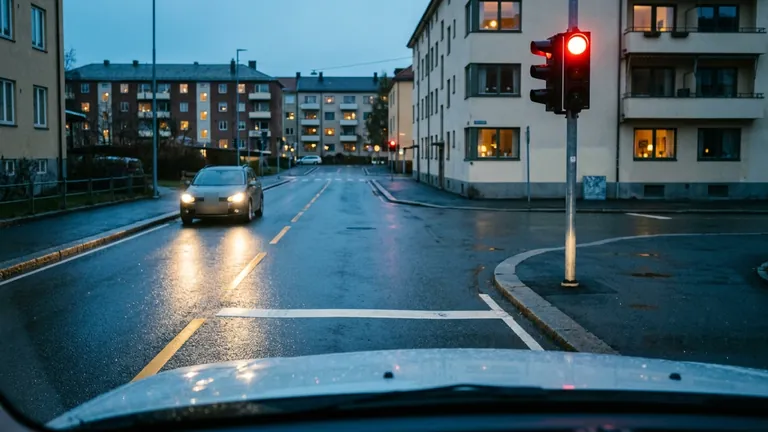
Traffic lights: red means stop, red-amber means get ready, green means drive if clear, amber means stop if you can.
Traffic lights
A green filter arrow gives clear passage in the arrow's direction, even when the main signal is red.
| Light | Meaning |
|---|---|
| Red | Stop. You must stop at the stop line. |
| Red and amber together | Get ready – it will soon turn green, but you must still wait. |
| Green | You may drive if the road is clear and you are not causing an obstruction. |
| Amber | Stop if you can do so safely. Only continue if stopping suddenly would be dangerous. |
Light signals regulate entry into the junction, but they do not remove responsibility for checking the rest of the situation. You must still look for pedestrians, cyclists, oncoming traffic when turning, emergency vehicles and whether you can get all the way through without blocking the road.
The order of priority in traffic control
When several forms of control apply at once, the order is fixed. Police signals come first. Next come light signals, signs and road markings, all of which override the general traffic rules – and where a light signal and a give-way sign disagree, the light applies.
- 1. Directions from the police (or others with such authority, such as Statens vegvesen at a check).
- 2. Light signals, signs and road markings. A traffic light overrides give-way signs.
- 3. The traffic rules, such as giving way to the right.
Police signals come before everything. Lights, signs and markings come before the traffic rules – and a light signal comes before a give-way sign.
Police signals may be a hand movement, body position or clear direction from a person directing traffic. You should reduce speed, seek eye contact if possible and follow the signal even if the light or sign says something else.
- An arm stretched out to the side: those coming from ahead or from behind must stop. Those coming from the sides may drive.
- An arm raised straight up: everyone must stop. If you are already so far into the junction that stopping would be dangerous, drive out of it.
- A red lamp waved back and forth: if you are driving towards the light, you must stop.
The position of the arm is the whole message – read it before you look at the light.
| You see | First correct thought |
|---|---|
| Police directing at a junction | Follow the police, not the traffic light. |
| Red light at a level crossing | Stop and wait; train warnings must be treated strictly. |
| Flashing or failed traffic lights | Look for signs and then use the ordinary give-way rules with extra care. |
| Green light, but queue beyond the junction | Wait before the junction; do not block crossing traffic. |
Flashing amber allocates nothing: find the sign, and if there is none, the right-hand rule applies.
Level crossing: Where a road and railway cross at the same level. Often has a light signal, barrier and sound signal that warn of trains.