
Class B theory course · chapter 3 of 22
The car – construction and systems
The car's main systems, brakes and driver assistance, tyres and grip, plus lights, visibility and the particulars of electric cars.
The chapter in numbers
- Lessons
- 4about 25 minutes of reading
- Drawings
- 9diagrams and photographs made for the lessons they sit in
- Exam tips
- 7passages that say what the test tends to ask here
- Terms
- 5words explained where they are first used
Why this chapter
You do not need to be a mechanic, but you must understand what makes the car go, stop and steer – and where the limits are. Brakes, ABS and stability control, tyres and grip, lights and visibility, and what is different about an electric car: this chapter gives you what you need to answer correctly and drive safely.
Written against
The lessons are written against these sources, and the explanations cite them.
- Læreplan klasse B
- vegvesen.no – kjøretøy
- vegvesen.no
- Kjøretøyforskriften
- vegvesen.no – dekk og kjetting
- Trafikkreglene
What the test asks
The practice questions for this chapter belong to one of the seven official themes of the theory test.
The mock-exam split is our own – Statens vegvesen publishes none.
The lessons, in order
- 1 The car's main systemsAn overview of the systems that make the car go, stop and steer – and why you should understand them. 3 min
- 2 Brakes, steering and driver assistanceHow the brakes and steering work, and what ABS, ESC and other assistance systems do. 9 min
- 3 Tyres and road gripThe role of the tyres, tread depth, air pressure and the difference between summer and winter tyres. 7 min
- 4 Lights, visibility and the distinctive features of electric carsThe car's light groups and their use, visibility through the windows, and what is special about electric cars. 6 min
The lessons are part of full access – 149 kr for a week, 199 kr for a month. Chapter 1 is free, so you can see how the course is written first.
All 22 chapters
- 01Introduction
- 02The human in traffic
- 03The car – construction and systems
- 04Checks and maintenance
- 05The road and the traffic environment
- 06The traffic rules and basic duties
- 07Signs, signals and police directions
- 08Giving way and right of way
- 09Observation and communication
- 10Positioning and lane use
- 11Speed, distance and braking distance
- 12Junctions and roundabouts
- 13Overtaking and meeting
- 14Different roads and surroundings
- 15Light and road-surface conditions
- 16Other road users
- 17Stopping and parking
- 18Eco-friendly driving
- 19Load and trailer
- 20The driver's responsibility
- 21At a traffic accident
- 22Risk and attitudes
Read the whole chapter
Full access opens all 22 chapters, mock exams with new questions every time and the sign drill – 149 kr for a week, 199 kr for a month, no automatic renewal.
The car's main systems
You do not need to be a mechanic to get a driving licence, but you must understand the car well enough to use it safely and discover faults before they become dangerous. A modern car is made up of several systems that work together. When you know the role of each system, you also understand why warning lights, strange noises or changed behaviour should be taken seriously.
The most important systems
- Engine and power transmission: provide movement and transfer power to the wheels.
- Brakes: reduce speed and keep the car stationary. The most important safety system you have.
- Steering: lets you change direction precisely and predictably.
- Wheels and tyres: the car's only contact with the road – all speed, steering and braking go through them.
- Lights and visibility: make sure you see and are seen.
- Safety equipment: seat belts, airbags, head restraints and the body's deformation zones.
The engine produces power, but that power must be controlled before it reaches the wheels. A clutch or automatic transmission connects the engine gradually, the gearbox selects the ratio, and the drivetrain sends power to the driving wheels. A low gear gives strong pulling force at low speed, while a high gear gives calmer engine running once the car is moving.
Why understand the car?
As the driver, you are responsible for the car being in roadworthy condition every time you drive. If you know the systems, you understand what a warning light means, why the braking distance increases on a slippery road surface, and when you should stop and get help instead of driving on.
The colour, not the symbol, tells you how urgent it is: red means stop, yellow means get it checked soon.
Active safety: Features and equipment that help the driver avoid an accident, for example good brakes, good road grip and good visibility.
Brakes, steering and driver assistance
The brakes are the car's most important safety system. They convert movement into heat and reduce speed. A normal braking system is divided into two circuits, so that you retain some braking effect even if one circuit should fail.
The foot brake works hydraulically: pedal force becomes pressure in the brake fluid, and the pressure pushes pads or shoes against discs or drums at the wheels. Friction turns movement energy into heat. That is why brakes can lose effect if they become too hot, or if fluid/air in the system does not transfer the pressure correctly.
The circuits are split diagonally. If one fails you still brake on two wheels – but the pedal goes further and so do you.
Service brake and parking brake
- You use the service brake (foot brake) while driving to reduce speed and stop.
- The parking brake (handbrake or electric) keeps the car stationary when it is parked.
- Engine braking occurs when you release the accelerator while in gear; it relieves the foot brake on long downhill gradients.
| Pedal feel | Possible explanation | What you do |
|---|---|---|
| Spongy or springy | Air or moisture in the brake fluid | Do not drive further than necessary; have the brakes checked |
| Pedal sinks while you hold pressure | Leak or serious hydraulic fault | Stop safely and get help |
| Hard pedal and weak braking | No brake servo assistance or system fault | Reduce speed, stop safely and investigate |
| The car pulls to one side when braking | Uneven brake effect or unequal grip | Have the fault repaired before normal driving |
ABS and electronic assistance systems
Modern cars have several systems that help you retain control, but they do not cancel the laws of physics. They give you a little more margin – they do not remove the need for adapted speed and a good distance.
| System | What it does |
|---|---|
| ABS | Prevents the wheels from locking during hard braking, so that you can steer while braking. |
| ESC / anti-skid | Automatically brakes individual wheels if the car starts to skid, and helps you keep a steady course. |
| Traction control (TCS) | Prevents the driving wheels from spinning during acceleration on a slippery surface. |
| Brake assist | Quickly increases braking force in an emergency when the system detects panic braking. |
ESC brakes a single wheel and twists the car back on course. It cannot create grip that is not there.
A locked wheel slides where the car already points. Keep the pedal down – with ABS the wheel rolls enough for you to steer around.
Steering
Power steering makes the steering wheel easy to use. If you notice that the steering suddenly becomes heavy, that the car pulls to one side, or that the steering wheel vibrates, it may be a sign of a fault – for example low tyre pressure, a fault in the power steering or uneven tyre wear. You should then investigate the cause before driving further.
Steering is also affected by load, tyres and speed. Heavy load far back or on the roof can make the car slower to turn and more unstable in an evasive manoeuvre. Incorrect wheel alignment or unequal tyre pressure can cause uneven wear and make the car wander or pull to one side.
Simple tests you can do yourself
| Test | How to do it | What you are looking for |
|---|---|---|
| The footbrake | Press the pedal hard and hold the pressure for about 20 seconds | The pedal should stay put. If it sinks slowly, there may be a leak. If it feels spongy, there may be air in the system. If it goes unusually far down, the pads may be worn. |
| The brake servo | Pump the pedal a few times with the engine off, hold the pedal down and start the engine | The pedal should sink slightly when the engine starts. If nothing happens, you are getting no help from the servo, and the pedal will be hard. |
| The parking brake | Apply it and try to drive off gently | The car should be held back. If it does not work, it will not hold the car on a slope either. |
| The brakes after water | Brake lightly and in a controlled way for a short distance after a car wash or a deep puddle | The heat dries off the film of water between pad and disc, so full braking effect returns. |
Understeer and oversteer
When grip fails, it rarely fails equally at the front and the rear. Which end lets go first decides what the car does - and both nearly always start with too much speed into the bend.
| Type | What lets go | Typical causes |
|---|---|---|
| Understeer | The front wheels. The car wants to go straight on even though you turn the wheel further. | Too much speed into the bend, aquaplaning on the front wheels, worn or under-inflated front tyres, heavy load at the front, hard acceleration in a front-wheel-drive car. |
| Oversteer | The rear wheels. The back slides outwards and the car turns more sharply than you intended. | Hard braking or lifting off mid-bend, aquaplaning on the rear wheels, worn or under-inflated rear tyres, heavy load right at the back, a trailer, crosswind. |
Cruise control and adaptive cruise control
Cruise control holds a set speed without you keeping your foot on the accelerator. Adaptive cruise control uses radar or a camera and also keeps the distance to the car ahead by accelerating and braking on its own. Both are comfort systems. They do not watch the road for you, and they do not move responsibility for your speed away from the driver.
- Ordinary cruise control holds the speed even when the car ahead slows down – there you have to brake yourself.
- The system disengages when you brake, and on most cars also when you press the clutch.
- Adaptive cruise control is poor at seeing a vehicle that is already stationary, and can react late to a queue that has come to a complete stop.
- On a long downhill the system cannot always hold the speed down on engine braking alone, and the speed creeps over the limit.
ABS: Anti-lock brakes. Prevents the wheels from locking during hard braking, so that the driver can steer and brake at the same time.
Tyres and road grip
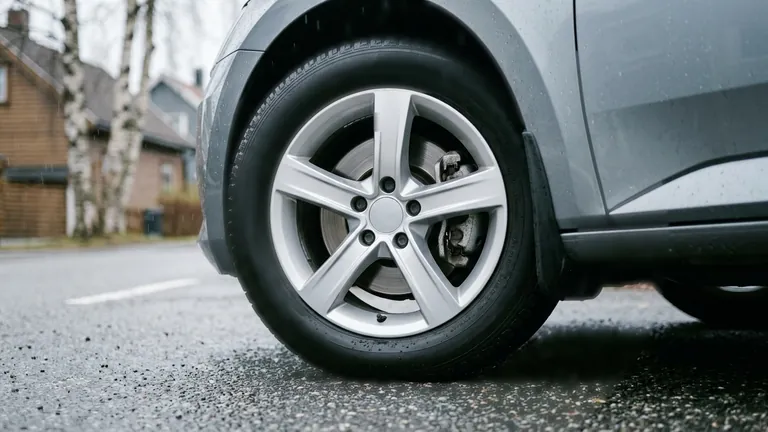
The tyres are the car's only contact with the road. The total contact patch with the surface is no bigger than a few palms. All acceleration, steering and braking must happen through these small patches. The condition of the tyres is therefore absolutely crucial for safety.
Four patches the size of your palms carry everything you ask the car to do.
Tread depth
The tread channels away water, snow and slush so that the rubber makes contact with the road surface. Worn tyres give poorer grip and a much longer braking distance, especially on wet and slippery roads.
| Period | Minimum legal tread depth |
|---|---|
| From the first Monday after Easter Monday to 31 October | 1.6 mm |
| From 1 November to the first Sunday after Easter Monday | 3.0 mm |
The tread must push the water away in time. If it is too shallow, or the speed too high, the tyre rides up on the water.
Air pressure
- Too low pressure gives higher fuel consumption, poorer steering and a risk that the tyre will overheat.
- Incorrect pressure gives uneven wear and a shorter service life.
- Check the pressure when cold, and use the values specified by the car manufacturer (often on a label in the door frame or in the fuel filler flap).
| Fault | Typical effect |
|---|---|
| Too low pressure | The tyres heat up, steering becomes slower, consumption increases and the tyre shoulders wear |
| Too high pressure | Smaller contact patch, harsher ride and more wear in the centre of the tyre |
| Unequal pressure on the same axle | The car may pull to one side, especially when braking or avoiding an obstacle |
| Too low pressure with heavy load | Extra heat and greater risk of tyre damage on a long trip |
The wrong pressure moves the contact patch: too low wears the shoulders, too high wears the centre – and grip suffers either way.
Summer tyres and winter tyres
Winter tyres have a softer rubber compound and a tread pattern that gives grip on snow and ice. Studded tyres provide extra grip on ice, but cause more wear to the road and may be used only during a specified winter period. Non-studded winter tyres can be used all year, but are not made for summer heat. Whatever the tyre type, you as the driver are responsible for the car having tyres that suit the road conditions.
Markings you should recognise
- The Alpine symbol - a mountain with a snowflake inside - shows the tyre has been tested and approved for winter conditions. The letters M+S alone are not the same; they are only a manufacturer's claim with no test requirement.
- Tread wear indicators are small rubber bars down in the tread grooves. When the tread has worn level with them, the tyre is at the legal minimum for summer tyres and must be replaced.
- The production date is four digits in an oval on the sidewall: week and year. Rubber ages and hardens even when the tyre still has plenty of tread depth.
Spare wheel and punctures
| Type | What it is | What to remember |
|---|---|---|
| Full-size spare wheel | Same dimension and type as the other wheels | Can be used as a normal wheel, but one brand-new tyre together with three worn ones gives uneven grip. Have the original wheel repaired and refitted. |
| Space-saver spare | A narrower and weaker spare wheel | Only for getting to a workshop. The registration document or handbook gives the maximum speed, maximum distance and tyre pressure - often 80 km/h. |
| Repair kit | Sealant and a compressor instead of a wheel | A temporary emergency fix that will not seal large cuts or sidewall damage. Drive gently and straight to a workshop. |
Tread depth: The depth of the grooves in the tyre. Channels away water and snow so that the tyre gets grip. At least 1.6 mm in summer and 3.0 mm from 1 November to the first Sunday after Easter Monday.
Lights, visibility and the distinctive features of electric cars
Seeing and being seen is a prerequisite for safe driving. The car has several groups of lights, each with its own task, and you must know when to use which.
Light groups
| Lights | When you use them |
|---|---|
| Daytime running lights / dipped headlights | The car must have lights on throughout the day and night, all year. Dipped headlights are used in darkness, tunnels and poor visibility. |
| Main beam | In darkness without road lighting and when you are not dazzling others. Dip in good time when meeting oncoming traffic and when following someone. |
| Parking lights | To be seen when the car is stationary in a place with poor visibility. |
| Rear fog light | Only in dense fog or heavy snow. Switch it off as soon as visibility improves, otherwise you dazzle those behind you. |
| Brake lights and indicators | Warn those behind you that you are braking or are going to turn/change lanes. |
Dipped beam stops well short of the pedestrian. On dipped headlights your speed must match how far the light reaches.
Visibility
- Clean windows, mirrors and lights are part of the daily check – dirt and ice steal visibility.
- Working windscreen wipers and washer fluid that tolerates cold are necessary all winter.
- Make sure you have clear visibility before driving; scrape all ice and remove snow from the roof and lights.
Electric car and hybrid
More and more people drive electric cars. They have some distinctive features you should know, but the same traffic rules apply fully.
- The electric car is almost silent at low speed – vulnerable road users do not hear you coming, so be extra attentive near pedestrians and cyclists.
- Powerful and instantaneous acceleration means that speed increases quickly; it requires a conscious accelerator foot.
- Regenerative braking (engine braking) charges the battery when you release the accelerator, and reduces wear on the ordinary brakes.
- Range falls in cold weather and at high speed – plan charging on longer journeys.
Lift off and the motor becomes a generator, slowing the car. The foot brake must still always be ready.
Electric cars are often heavy because of the battery. High weight can feel stable, but it increases the energy that must be stopped in an emergency braking and can increase tyre wear. Combined with quick acceleration, steady speed, good distance and correct tyre pressure become especially important.
The safety equipment built into the car
The bodyshell is not just a skin. The front and rear are designed to deform in a controlled way in a crash, so the forces build up over time rather than hitting your body in an instant. The passenger cell around you, by contrast, is designed to keep its shape. The sides are the weakest direction, because there is so little space between you and whatever you hit - which is why side airbags and reinforced pillars matter so much.
Belt and airbag work together
- The three-point belt spreads the forces over hip, chest and shoulder. That is far better than a lap belt alone, which only holds you back at the waist.
- The belt tensioner pulls the belt tight against your body the moment the crash begins, so you do not build up speed before the belt catches you.
- Thick outer clothing puts several centimetres of slack into the belt. Take off the padded jacket before you buckle up.
- The airbag inflates in about a hundredth of a second and only fires in an impact of a certain force - low speeds do not set it off.
- Sit at least about 25 cm from the steering wheel. Closer than that and the bag can hit you while it is still inflating.
- An airbag without a belt is dangerous: without the belt you meet the bag before it has finished deploying.
Whiplash: An injury caused when the head is thrown backwards and then forwards, most often in a rear-end collision. A correctly adjusted head restraint - top edge level with the top of the head and as close to the back of the head as possible - is what limits the movement.
Regenerative braking: The electric car's ability to brake by letting the electric motor act as a generator and charge the battery, instead of only using the ordinary brakes.