
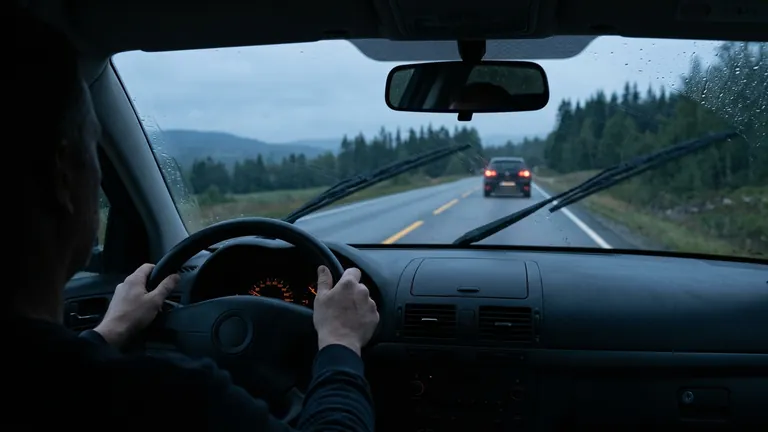
Class B theory course · chapter 2 of 22
The human in traffic
Senses, perception and reaction time, speed and distance, vulnerable road users, and how your condition, alcohol and intoxication affect your ability to drive.
The chapter in numbers
- Lessons
- 7about 21 minutes of reading
- Drawings
- 18diagrams and photographs made for the lessons they sit in
- Exam tips
- 6passages that say what the test tends to ask here
- Terms
- 4words explained where they are first used
Why this chapter
Most crashes are caused not by the car or the road but by the person behind the wheel. This chapter is about how we see, perceive and react – and what fatigue, stress, intoxication and peer pressure do to judgement. It sits underneath almost every other question in the theory.
Written against
The lessons are written against these sources, and the explanations cite them.
- Læreplan klasse B
- trafikkreglene § 3
- trafikkreglene
- trafikkreglene § 5
- Trafikkreglene § 7, § 9
- læreplan klasse B
- vegtrafikkloven § 21
- Vegtrafikkloven § 22
- vegvesen.no
What the test asks
The practice questions for this chapter belong to 3 of the seven official themes of the theory test.
- Speed & positioning236 practice questions · 7 of 45 in our mock exam
- Right of way256 practice questions · 9 of 45 in our mock exam
- Laws & rules156 practice questions · 5 of 45 in our mock exam
The mock-exam split is our own – Statens vegvesen publishes none.
The lessons, in order
- 1 The human being in trafficDriving is about making good decisions – all the time. 2 min
- 2 The senses and sightSight provides most of the information – and is impaired by speed, darkness and age. 4 min
- 3 Perception and reaction timeFrom when you see a hazard until you act, time passes – and the car keeps moving. 2 min
- 4 Speed, distance and braking distanceStopping distance = reaction distance + braking distance – and speed counts twice. 2 min
- 5 Consideration for vulnerable road usersPedestrians, cyclists, children and older people are most exposed – they need your caution. 2 min
- 6 Condition and fitness to driveTiredness, illness, emotions and distraction impair you as a driver. 4 min
- 7 Alcohol and intoxicationThe blood alcohol limit is 0.2 ‰ – but even smaller amounts impair your driving ability. 5 min
The lessons are part of full access – 149 kr for a week, 199 kr for a month. Chapter 1 is free, so you can see how the course is written first.
All 22 chapters
- 01Introduction
- 02The human in traffic
- 03The car – construction and systems
- 04Checks and maintenance
- 05The road and the traffic environment
- 06The traffic rules and basic duties
- 07Signs, signals and police directions
- 08Giving way and right of way
- 09Observation and communication
- 10Positioning and lane use
- 11Speed, distance and braking distance
- 12Junctions and roundabouts
- 13Overtaking and meeting
- 14Different roads and surroundings
- 15Light and road-surface conditions
- 16Other road users
- 17Stopping and parking
- 18Eco-friendly driving
- 19Load and trailer
- 20The driver's responsibility
- 21At a traffic accident
- 22Risk and attitudes
Read the whole chapter
Full access opens all 22 chapters, mock exams with new questions every time and the sign drill – 149 kr for a week, 199 kr for a month, no automatic renewal.
The human being in traffic
Driving a car means making decisions in a steady stream. You perceive what is happening around you, assess what may happen, and act – again and again. Most accidents are not due to poor driving technique, but failures in perception, judgement or attention.
Safe driving is not just quick reactions. The quality of your decision depends on what you notice, what you understand about the situation, the experience you use, and the values guiding your choice. A driver who “handles the car well” but chooses small margins still has poor decision quality.
Look – assess – act
A good driver reads the traffic well ahead, plans and stays ahead of events. Then you have time to perceive hazards early, weigh up the options and act calmly – instead of being surprised and having to react abruptly.
Look, assess and act is one loop you run again and again – not a one-off decision.
The senses and sight
About 90 % of the information you use when driving comes through sight. Good eyesight and good use of sight are therefore crucial. Hearing helps you perceive emergency vehicles and signals, but sight is the most important sense.
Sharp central vision and peripheral vision
You see sharply only where your gaze is actually directed. The rest of the field of vision warns you about movement and contrasts, but not details. That is why you must scan: far ahead, the near zone, mirrors, side roads and back again. Your gaze must not lock onto one hazard while other hazards may develop at the same time.
Only a small field is sharp. The rest just reports movement – so your gaze must keep moving.
Only a small area in the middle of the field of vision is completely sharp. Peripheral vision (side vision) is blurred, but good at detecting movement. Therefore you must move your gaze actively and read the whole traffic picture – not stare straight ahead.
The higher the speed, the narrower the field of vision you manage to use.
Darkness and dazzle
The eyes need time to adjust between light and darkness. After being dazzled, you may think you can see the road, while contrasts, pedestrians in dark clothing and roadside obstacles disappear. The correct speed in darkness is therefore the speed that lets you stop within the part you can actually see well enough.
The right speed in the dark is the one that lets you stop inside your beam.
- In the dark you see less far and perceive distances and speed less accurately.
- The eyes take time to adapt to darkness – and to recover after being dazzled.
- Use main beam when you can, but dip your headlights for oncoming traffic and for the person you are driving behind.
How much of the visual field is sharp?
Your visual field covers roughly 180 degrees, almost a semicircle. But only 1-2 per cent of it is sharp vision - about the size of a thumbnail at arm's length. The remaining 98-99 per cent is peripheral vision: blurred, weak on colour and almost useless for reading a sign, but very good at detecting movement.
Your eyes can deceive you
The brain fills in what you do not have time to see, guessing from experience. That is useful, but sometimes it guesses wrong. The result is an optical illusion - you see something other than what is actually there.
| Illusion | What happens | What it means for you |
|---|---|---|
| Car with only one headlight | You read the single light as a motorcycle or moped | You position too close to the centre and suddenly meet a full-width car |
| Motorcycle read as a moped | A small silhouette seems slow | You pull out at the junction in front of something far faster than you thought |
| Snow smoke from the car ahead | Snow is whipped up and you lose reference points | You become disorientated and see neither edge, centre line nor brake lights |
| Long, even road | Nothing in the visual scene changes | Speed feels lower than it is, and your gaze stops searching |
Your other senses
- Hearing alerts you to emergency vehicles, horns and an engine running abnormally.
- Balance and touch tell you how the car is sitting on the road, and are often the first to report that grip is starting to fail.
- Smell reveals hot brakes, burning electrics, coolant and a fuel leak.
- Loud music, earphones and cabin noise take these warnings away.
Peripheral vision: Side vision outside the sharp area. Blurred, but sensitive to movement – warns you about something approaching from the side.
Perception and reaction time
Even an attentive driver takes time from when a hazard appears until the foot is on the brake. This reaction time is usually around one second, but becomes longer if you are tired, distracted or under the influence.
Before the reaction comes, the brain must first choose what the signal means. An experienced driver recognises patterns: a child near a ball, a car creeping towards a stop line, or an oncoming car that may hide an overtaker. An inexperienced driver often sees the same thing later because the situation has not yet been sorted.
Reaction chain: you see, perceive, decide and act – everything takes time.
Reaction distance
During the reaction time, the car continues without you braking. This distance is called the reaction distance, and it becomes longer the faster you drive. At 80 km/h you travel about 22 metres in one second – before braking has even begun.
The car covers 22 metres while you only manage to move your foot – braking distance comes after that.
Two seconds on the phone plus one second of reaction add up to 67 metres.
Reaction distance: The distance the car travels during the reaction time, before you manage to start braking.
Speed, distance and braking distance
The stopping distance is the whole distance from when you discover a hazard until the car is stationary. It consists of two parts: the reaction distance (while you are not yet braking) and the braking distance (while the car is braking).
Stopping distance = reaction distance (yellow) + braking distance (red), here on dry, bare asphalt.
Speed counts twice
Speed also affects the human being before the brakes are used. At higher speed you have less time to notice details, less time to assess options and a longer reaction distance. A gap that felt safe at low speed may become dangerous when speed is high.
Braking distance increases with the square of speed. If you double your speed, the braking distance becomes about four times as long. A little more speed therefore gives a much longer distance to stop – and much greater energy in a collision.
If you double your speed, braking distance quadruples.
Keep your distance: the three-second rule
A simple way to keep enough distance is the three-second rule: choose a fixed point by the road, and make sure at least three seconds pass from the car in front passing the point until you do so yourself. On a slippery road surface or in poor visibility, you need even more.
Keep at least three seconds to the car in front – more when it is slippery or dark.
Consideration for vulnerable road users
Vulnerable road users – pedestrians, cyclists and others without bodywork around them – have no protection in a collision. As a car driver, you have a special responsibility to take them into account.
Give cyclists and pedestrians plenty of space, and reduce speed where they travel.
Groups requiring extra caution
Children do not assess traffic like adults. They are short, easily hidden, may have a narrow attention field and often act from play or an immediate goal. A child running after a ball is not making a “traffic assessment” – the child is following an impulse.
Children are short and easily hidden between parked cars. The ball is the warning you get.
Older people and people with disabilities may need more time, more space and clearer signals. A white cane or guide dog means you must show special consideration, keep low speed and stop if necessary. Do not pressure a quick decision with the car.
- Children are unpredictable, small and easy to miss – they do not understand speed and distance.
- Older people may move slowly and have reduced sight and hearing.
- Cyclists may wobble, turn and arrive faster than you think.
- Motorcyclists and moped riders are narrow and easy to miss, especially at junctions.
You sit inside a protective shell. The person you meet outside the car does not.
Condition and fitness to drive
You must never drive a motor vehicle if you are not able to drive safely. The Road Traffic Act says that you must not drive when you are ill, tired, under the influence or in a condition that means you do not have full control.
Fitness to drive varies from day to day. What was safe yesterday may be unsafe today if you slept little, are ill, have argued, are in pain or must share attention with strong worries. The driver must assess their own condition before turning the key.
Assess your condition before the trip, not after something has gone wrong.
Tiredness
The body warns you before you fall asleep. Recognise one of these and the trip is over.
- Tiredness gives longer reaction time and poorer judgement – almost like being under the influence.
- Microsleep for a few seconds at high speed can be enough for a serious accident.
- Take a break, sleep, or do not drive. Fresh air and coffee only postpone the problem.
Illness, emotions and medicines
- Strong emotions such as anger, grief or stress impair concentration.
- Illness and fever make you slower and less attentive.
- Some medicines cause drowsiness and may make it illegal to drive – read the package leaflet and ask your doctor.
How to recognise tiredness
Tiredness announces itself with bodily signs long before you fall asleep. The problem is that they come gradually, and that the same tiredness that makes you dangerous also makes you worse at judging how tired you are.
- Blurred or flickering vision, and eyelids growing heavy.
- Repeated yawning and a dry mouth.
- You feel cold, even though the car is not cold.
- You cannot hold a steady speed, and keep making small steering corrections.
- Your head feels heavy, and you overreact to small things.
- You cannot remember the last few kilometres you drove.
What works - and what only postpones
| Measure | Effect |
|---|---|
| Proper sleep | The only thing that actually removes the need for sleep. |
| A short nap of 15-30 minutes | Gives real but short-lived improvement. Do not sleep longer than 30 minutes, or you wake up heavier than you lay down. |
| Caffeine | Works roughly like a short nap, and only after 15-30 minutes. Coffee followed by a nap is the combination that works best. |
| Fresh air, music, an open window | Makes you alert for a few minutes. Does not remove the need for sleep, and gives you a false sense of control. |
Microsleep: A few seconds or fractions of a second of sleep that you often do not notice yourself. At 80 km/h the car travels about 22 metres per second - with no driver at all.
Sleep apnoea: A condition where breathing repeatedly stops during sleep. Sleep becomes fragmented, and the driver can be seriously tired during the day without understanding why. The condition can be treated, and it is relevant to the health requirements for a licence.
Alcohol and intoxication
Alcohol impairs judgement, reaction time, sight and coordination. In Norway, the blood alcohol limit is 0.2 ‰. But harmful effects begin even below the limit – no amount of alcohol makes you a better driver.
The danger with alcohol is the combination: ability goes down while confidence often goes up. You may feel calm, brave or “sharper”, but you judge risk worse, detect hazards later and often choose smaller margins.
Alcohol lowers ability and raises confidence at the same time – the gap between them is the risk.
| Effect | What it means in traffic |
|---|---|
| Narrower attention | You may stare at one thing and miss what happens to the side. |
| Poorer distance and speed judgement | Gaps may seem larger than they are, and your own speed may feel lower. |
| Weaker coordination | Steering, braking and gear changes become less precise when time is short. |
| Poorer self-criticism | You do not necessarily notice how impaired you are. |
The blood alcohol limit in Norway is 0.2 ‰. Above this, driving is punishable.
What you should know
Only time lowers your blood alcohol. Coffee and a shower make you awake, not sober.
- The body takes a long time to break down alcohol – you may still have a blood alcohol level the morning after.
- The penalty becomes more severe with increasing blood alcohol level, and you may lose the right to drive.
- The 0.2 ‰ limit also applies if you are the accompanying driver during practice driving.
Penalties by blood alcohol level
The penalty for drink-driving rises in steps with the blood alcohol level. The threshold for being counted as impaired is 0.2, but the consequences become much more severe above it.
| Blood alcohol | Typical consequence |
|---|---|
| Above 0.2 up to and including 0.5 | A fine. The fine is based on your income. |
| Above 0.5 up to and including 1.2 | A fine and a conditional or unconditional prison sentence. |
| Above 1.2 | A fine and an unconditional prison sentence. |
On top of that comes loss of the driving licence. The disqualification period is set according to the alcohol level and the circumstances, and at high levels or on repeat offences we are talking about several years and a requirement to retake the test. A drink-driving conviction also follows you in a police certificate and can make some jobs hard to get.
Other drugs work differently
| Group | Effect | The danger in traffic |
|---|---|---|
| Stimulants | Elation, restlessness and increased confidence | You overestimate your own driving ability, take bigger chances - and the tiredness that was suppressed can hit suddenly when the drug wears off |
| Depressants | Drowsiness, sluggishness and difficulty concentrating | Your reaction comes too late, and you notice hazards late or not at all |
| Hallucinogens | Distorted perception of reality and disorientation | You can read the traffic picture completely wrongly and act unpredictably |