
Class B theory course · chapter 10 of 22
Positioning and lane use
Positioning on the carriageway, choosing a lane, positioning before a turn, and safe lane changes.
The chapter in numbers
- Lessons
- 2about 8 minutes of reading
- Drawings
- 4diagrams and photographs made for the lessons they sit in
- Exam tips
- 2passages that say what the test tends to ask here
- Terms
- 2words explained where they are first used
Why this chapter
Where you place the car on the road is a message to everyone around you. This chapter explains positioning on a straight road, in bends and before junctions, changing lanes, and the rules for lane use on multi-lane roads and motorways. Correct positioning buys you visibility and time – and is often what separates a right answer from a wrong one.
Written against
The lessons are written against these sources, and the explanations cite them.
- Trafikkreglene
- læreplan klasse B
What the test asks
The practice questions for this chapter belong to one of the seven official themes of the theory test.
The mock-exam split is our own – Statens vegvesen publishes none.
The lessons, in order
- 1 Positioning on the carriagewayWhere you should normally position yourself on the road, and why correct positioning gives visibility and safety. 4 min
- 2 Positioning before turns and lane changesHow you position yourself before you turn, and how a safe lane change is made. 4 min
The lessons are part of full access – 149 kr for a week, 199 kr for a month. Chapter 1 is free, so you can see how the course is written first.
All 22 chapters
- 01Introduction
- 02The human in traffic
- 03The car – construction and systems
- 04Checks and maintenance
- 05The road and the traffic environment
- 06The traffic rules and basic duties
- 07Signs, signals and police directions
- 08Giving way and right of way
- 09Observation and communication
- 10Positioning and lane use
- 11Speed, distance and braking distance
- 12Junctions and roundabouts
- 13Overtaking and meeting
- 14Different roads and surroundings
- 15Light and road-surface conditions
- 16Other road users
- 17Stopping and parking
- 18Eco-friendly driving
- 19Load and trailer
- 20The driver's responsibility
- 21At a traffic accident
- 22Risk and attitudes
Read the whole chapter
Full access opens all 22 chapters, mock exams with new questions every time and the sign drill – 149 kr for a week, 199 kr for a month, no automatic renewal.
Positioning on the carriageway
Where you position the car determines both how well you see, how well you are seen, and how safe a margin you have to others. Correct positioning is one of the clearest differences between an experienced and an uncertain driver.
The main rule
You must drive as far to the right as is appropriate and safe, but not so far out that you end up in gravel, at edges or too close to vulnerable road users. The aim is a good margin to both oncoming traffic and the edge of the road.
Correct positioning is both rule and planning. You follow the main rule normally, but start early to position for the next task: meeting traffic, overtaking, junction, turn, narrowing or obstacle.
- Oncoming traffic: keep right and create side distance without ending up on an unsafe shoulder.
- Parked cars: keep distance from doors and people who may step out between the cars.
- Cyclists: rather wait behind until you can pass with good clearance than squeeze past.
- Poor visibility: choose a position that gives you more time, not just the shortest line.
Avoid driving for a long time in someone else’s blind spot. If you stay beside a lorry, bus or car without passing, you are harder to see and have fewer escape routes if the other vehicle moves.
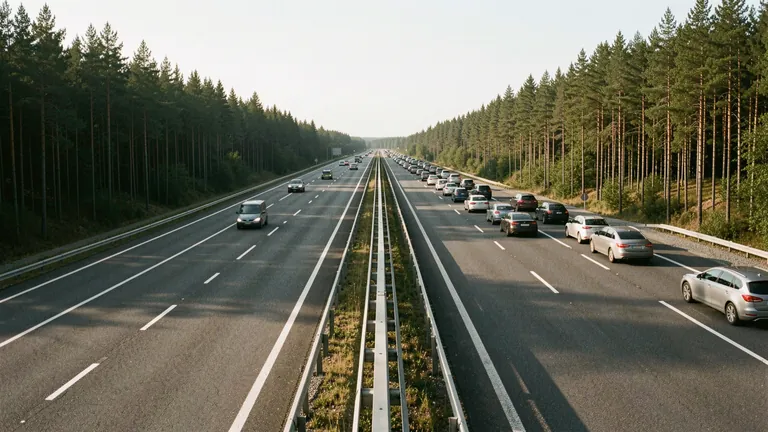
Several lanes in the same direction
- Normally stay in the right lane; the left lane is for overtaking.
- Choose lane in good time according to where you are going, especially before junctions and exits.
- Avoid staying in and “blocking” the left lane when the right lane is clear.
| Situation | Correct thinking | Why |
|---|---|---|
| Several lanes straight ahead | Choose lane according to where you are going next | Fewer late lane changes make traffic calmer |
| Signs or arrows on the road | Follow signs and markings before the main rule | Regulation may override normal lane use |
| One-way street | Use the right lane normally, but plan a left turn in time | Driving on the left can easily surprise pedestrians and crossing traffic |
| Public transport lane | Stay out unless you are allowed to use it | The lane must remain available for traffic with access |
Arrows on the carriageway tell you where the lane leads. Choose your lane long before the junction, not at the last moment.
If there is no room to give the cyclist wide clearance, wait behind until the road is clear.
Positioning: Where you place the car across the width of the lane. Correct positioning gives visibility and margin, and makes your intention clear to others.
Positioning before turns and lane changes
Good positioning before a manoeuvre makes it both safer and easier for others to understand. Turning or changing lane is just as much about the preparation as about the manoeuvre itself.
- Observe: look far ahead, mirrors, side areas and blind spot.
- Choose position: place the car early so others understand your direction.
- Adjust speed: brake and gear down before the actual turn or lane change.
- Signal: only when you know what is around you, and early enough for others to adapt.
- Carry out: calmly, precisely and only when it is clear.
Keep to the right before a right turn, and position yourself towards the centre before a left turn.
Before you turn
- Check mirrors and blind spot in good time.
- Signal so others understand what you are going to do.
- Position yourself correctly: towards the right before a right turn, towards the centre (within your own lane) before a left turn.
- Adapt your speed before the bend, not in it.
Before a right turn, position clearly towards the right within your own lane. Then you do not block traffic behind unnecessarily, you show your intention, and you reduce the risk of a cyclist or moped rider trying to pass on the inside. Before a left turn, position towards the centre of the carriageway, but still so that oncoming traffic has room. Do not cut the turn; rather wait until you can turn without entering the wrong lane.
Safe lane change
A lane change must never surprise anyone. Build it up in a fixed order, and it becomes both safe and predictable.
- Mirrors: see what is behind and beside you.
- Blind spot: make a quick shoulder check.
- Signal: indicate in good time.
- Manoeuvre: change lane smoothly when it is clear, and cancel the indicator afterwards.
The same order every time: mirrors, blind spot, signal, manoeuvre.
When you change lane, traffic in the lane you are entering has priority. Adapt your speed to that lane, find a gap without pressuring anyone, and cancel if the picture changes after the shoulder check.
In a roundabout, use positioning much like in an ordinary junction: to the right when turning right or going straight ahead unless signs say otherwise, and a clear position towards the left when going far around. Choose lane according to signs, markings and where you will exit.
Lane change: Changing lane. Done in the order mirrors, blind spot, signal and manoeuvre – and only when it is clear.