
Class B theory course · chapter 9 of 22
Observation and communication
Active use of your eyes and blind spots, and how you make yourself understood and read other road users in the interplay.
The chapter in numbers
- Lessons
- 2about 7 minutes of reading
- Drawings
- 3diagrams and photographs made for the lessons they sit in
- Exam tips
- 3passages that say what the test tends to ask here
- Terms
- 2words explained where they are first used
Why this chapter
Good driving means seeing early and being understood. This chapter covers where to look and how to use mirrors, blind spots, and signalling with indicators, position, lights and horn – in a way others can actually interpret. These are skills the practical test measures directly, and the theory test asks why they work.
Written against
The lessons are written against these sources, and the explanations cite them.
- Læreplan klasse B
- vegvesen.no
- trafikkreglene
What the test asks
The practice questions for this chapter belong to one of the seven official themes of the theory test.
The mock-exam split is our own – Statens vegvesen publishes none.
The lessons, in order
- 1 Active observation and use of visionLooking far ahead, shifting your gaze and building an up-to-date picture of the traffic around you. 4 min
- 2 Communication and interactionHow you make yourself understood, interpret others and build predictability into your driving. 3 min
The lessons are part of full access – 149 kr for a week, 199 kr for a month. Chapter 1 is free, so you can see how the course is written first.
All 22 chapters
- 01Introduction
- 02The human in traffic
- 03The car – construction and systems
- 04Checks and maintenance
- 05The road and the traffic environment
- 06The traffic rules and basic duties
- 07Signs, signals and police directions
- 08Giving way and right of way
- 09Observation and communication
- 10Positioning and lane use
- 11Speed, distance and braking distance
- 12Junctions and roundabouts
- 13Overtaking and meeting
- 14Different roads and surroundings
- 15Light and road-surface conditions
- 16Other road users
- 17Stopping and parking
- 18Eco-friendly driving
- 19Load and trailer
- 20The driver's responsibility
- 21At a traffic accident
- 22Risk and attitudes
Read the whole chapter
Full access opens all 22 chapters, mock exams with new questions every time and the sign drill – 149 kr for a week, 199 kr for a month, no automatic renewal.
Active observation and use of vision
Good driving begins with good observation. Experienced drivers look far ahead, shift their gaze systematically and spot hazards early – while they still have time and space to act calmly. Inexperienced drivers often fix their gaze too close ahead and notice things too late.
A fixed scanning routine
Active observation is not staring harder; it is letting your eyes work in a fixed rhythm. Start far ahead, take in what is coming closer, check the side areas and use the mirrors often enough to keep the picture around the car fresh.
- Far ahead: read queues, traffic lights, pedestrians, signs and possible obstacles before you must react.
- Near: control your own position, distance and grip without keeping your eyes just in front of the bonnet.
- Sides: search into side roads, pavements, cycle lanes and parked cars where something may emerge.
- Mirrors: update what is happening behind and beside you, especially before speed or position changes.
Let your gaze run the same round all the time: far ahead, near, the sides and the mirrors.
Look far, look wide, look often
- Raise your gaze and look far ahead, so you read the situation before it becomes urgent.
- Shift your gaze between what is far away, what is nearby, the mirrors and the instruments.
- Check the mirrors regularly, and always before you brake, change lane or turn.
- Build yourself a fresh picture of what is behind, beside and in front of you.
If you only read the road just in front of the bonnet, the hazard arrives too late. Aim your gaze at what is ten seconds away.
Your gaze should move in short, calm jumps. If you lock your eyes on one point, you lose the rest of the picture. If you turn your head from side to side for too long, you lose what is happening in front of the car.
Blind spots
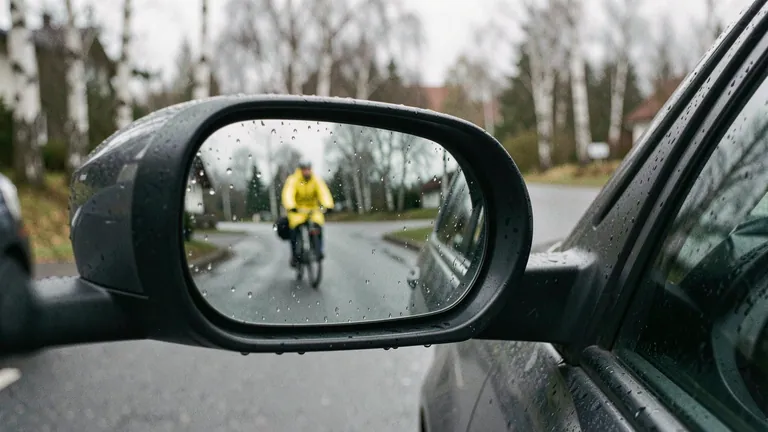
The mirrors do not cover everything. The areas diagonally behind the car, on both sides, are blind spots that the mirrors do not pick up. A cyclist, motorcyclist or car may be hidden there. That is why you must make a quick shoulder check before you change lane or turn.
The three mirrors overlap but leave a wedge open on each side. Only the shoulder check covers it.
Blind spot: The area diagonally behind the car on each side that the driver’s mirrors do not cover. Checked with a quick shoulder check.
Communication and interaction
Traffic is interaction. The vast majority of situations are solved without a word, because road users interpret each other’s speed, positioning and signals. Your task is to be clear and predictable, while also reading what others are going to do.
You communicate with more than the indicator. Speed, positioning, distance, brake lights, use of lights and eye contact tell others what you are likely to do.
Make yourself understood
- Signal in good time, and position the car so that your intention is clear.
- Drive smoothly and predictably – sudden and unexpected manoeuvres create uncertainty for others.
- Make eye contact with pedestrians and cyclists where possible, so you know about each other.
| Signal | What others can understand | Typical trap |
|---|---|---|
| Indicator | You intend to turn or change lane | Indicating without first checking mirrors and blind spot |
| Positioning | Which direction you are preparing for | Moving late or unclearly |
| Speed choice | Whether you intend to let someone pass, stop or continue | Entering an uncertain situation too fast |
| Eye contact | That you have noticed each other | Believing eye contact alone gives you priority |
Read the others
A car slowing down by a side road, a cyclist looking over their shoulder, or a child running towards the kerb – all of these are signals of what may happen. The earlier you pick them up, the more calmly you can act.
Pay special attention to small signs from two-wheelers. A cyclist who looks over a shoulder or moves slightly out may be about to pass a pothole, turn or avoid a door. Give room before the situation becomes tight.
Interaction: Road users adapting to each other through speed, positioning and signals, so that traffic flows safely without direct agreements.