
Class B theory course · chapter 4 of 22
Checks and maintenance
The daily check, fluids and wear parts, and the rules on the periodic technical inspection, registration document and approval.
The chapter in numbers
- Lessons
- 3about 18 minutes of reading
- Drawings
- 7diagrams and photographs made for the lessons they sit in
- Exam tips
- 4passages that say what the test tends to ask here
- Terms
- 3words explained where they are first used
Why this chapter
The driver is responsible for the car being in a safe condition – not the workshop. This chapter walks you through what you should be able to check yourself before driving: tyres and tread depth, lights, brakes, fluids and mirrors, and what the periodic inspection actually is. It is also the foundation for the safety check on the practical test.
Written against
The lessons are written against these sources, and the explanations cite them.
- Læreplan klasse B
- vegvesen.no
- kjøretøyforskriften
- Kjøretøyforskriften
- vegvesen.no – EU-kontroll
What the test asks
The practice questions for this chapter belong to one of the seven official themes of the theory test.
The mock-exam split is our own – Statens vegvesen publishes none.
The lessons, in order
- 1 Your daily checkA simple routine before you drive, and what you should look, listen and feel for on the way. 8 min
- 2 Fluids and wear partsThe oil, coolant, brake fluid, washer fluid and the parts that wear over time. 5 min
- 3 EU control, registration certificate and approvalThe periodic technical inspection, the vehicle registration certificate, and what makes the car legal to use. 5 min
The lessons are part of full access – 149 kr for a week, 199 kr for a month. Chapter 1 is free, so you can see how the course is written first.
All 22 chapters
- 01Introduction
- 02The human in traffic
- 03The car – construction and systems
- 04Checks and maintenance
- 05The road and the traffic environment
- 06The traffic rules and basic duties
- 07Signs, signals and police directions
- 08Giving way and right of way
- 09Observation and communication
- 10Positioning and lane use
- 11Speed, distance and braking distance
- 12Junctions and roundabouts
- 13Overtaking and meeting
- 14Different roads and surroundings
- 15Light and road-surface conditions
- 16Other road users
- 17Stopping and parking
- 18Eco-friendly driving
- 19Load and trailer
- 20The driver's responsibility
- 21At a traffic accident
- 22Risk and attitudes
Read the whole chapter
Full access opens all 22 chapters, mock exams with new questions every time and the sign drill – 149 kr for a week, 199 kr for a month, no automatic renewal.
Your daily check
Before you drive, you are responsible for the car being in roadworthy condition. You do not need to do a full technical check every day, but a quick, fixed routine reveals the most common faults before they become dangerous. It takes less than a minute once it is second nature.
Around the car and inside the car
- Tyres: look for visibly low tyres, cuts or damage.
- Lights and mirrors: intact, clean and correctly adjusted. Preferably get someone to check that the brake lights and indicators work.
- Windows: clean, intact and free of ice and snow.
- Securing: adjust the seat, head restraint and mirrors before driving, and fasten your seat belt.
- Warning lights: look over the instrument panel when you start – lights that stay on mean a fault you should check.
Adjust the seat first, then the mirrors. A correct driving position gives you control over the pedals and the wheel, and makes the head restraint actually protect you in a rear-end collision.
- Seat: your knee should be slightly bent when the pedal is pressed fully down.
- Backrest: back against the seat, and the arm slightly bent with the wrist on top of the wheel.
- Head restraint: its top edge should reach the top of your head.
- Mirrors: set them after the seat, not before.
Set the mirrors after the seat, so the fields just meet. What is left beside you is the blind spot – you must turn your head to see it.
| Sign | Typical risk | Correct reaction |
|---|---|---|
| Red brake lamp stays on | Parking brake on, low fluid or brake fault | Stop and find the cause before driving on |
| Oil pressure lights while driving | The engine may lack lubrication | Stop the engine safely as soon as possible |
| Temperature warning or steam | Overheating and risk of engine damage | Stop safely, let the engine cool, do not open a hot pressure cap carelessly |
| Yellow engine/ABS lamp | The system may have reduced function | Drive carefully for inspection if the car is otherwise safe |
Look, listen and feel while driving
The car tells you a lot if you pay attention. Unusual sounds, a smell of burning or petrol, vibrations in the steering wheel, the car pulling to the side, or the brake pedal feeling different – all these are signals you should take seriously.
The car often warns you through sound, smell or feel before any lamp comes on. Take the signal seriously straight away.
A fixed round of the car
The safety check is also something you can be asked to show and explain on the practical test. The point is not to memorise a list, but to have an order that means nothing gets skipped.
| Step | Outside | Inside |
|---|---|---|
| 1 | Turn on the lights and walk round the car: dipped beam, rear lights, plate light, reflectors and indicators on both sides. | Adjust seat, head restraint and mirrors, and check that all doors are properly closed. |
| 2 | Look at each tyre: tread depth, cuts, uneven wear, and whether the tyre looks flat at the bottom. | Try the wipers and washers, and check that the fan and windscreen heater work. |
| 3 | Check that windows, mirrors and light lenses are clean and undamaged. | Press the footbrake down hard - it should feel firm - and check the parking brake. |
| 4 | Ask someone to press the brake while you stand behind the car, and see that the brake lights come on. | Start the engine and look over the warning lights: any that stay on mean a fault you have to deal with. |
The warning lights on the instrument panel
When you switch on the ignition, most warning lights come on for a moment while the car tests itself, then go out. A light that stays on – or comes on while you are driving – is the car telling you something. The colour tells you how urgent it is.
| Colour | What it means | What you do |
|---|---|---|
| Red | A serious fault, or a risk of damage to you or the car. | Stop as soon as you find a safe place, and do not drive on before the fault has been checked. |
| Yellow or amber | A fault or reminder that is not urgent. | Drive on carefully, and have it checked soon. |
| Green or blue | Information about something that is switched on, such as an indicator or main beam. | Nothing. A blue light means main beam, and should go out when you dip. |
- Red oil can: oil pressure too low. Stop the engine at once – it can be ruined in minutes.
- Red battery symbol: charging has failed. The car is running on the battery alone and will stop after a while.
- Red temperature light: the engine is overheating. Stop and let it cool before you open anything.
- Red exclamation mark in a circle: a fault in the braking system – or simply the parking brake left on.
- Yellow engine light: a fault in the engine management or emission control. The car can be driven, but must be checked.
- Yellow ABS light: ABS is out of action. You still have ordinary brakes, but the wheels can lock under hard braking.
- Yellow tyre-pressure light: the pressure is too low in at least one tyre.
Roadworthy condition: That the car is safe to use: brakes, steering, tyres, lights and visibility work as they should, and the car has no faults that make it dangerous in traffic.
Fluids and wear parts
A car needs several fluids to work, and some parts gradually wear. Keeping an eye on these is part of owning and using a car safely. You can check much of it yourself; the rest belongs in a garage.
Fluids you should know about
| Fluid | Function |
|---|---|
| Engine oil | Lubricates and cools the engine. Too little oil can destroy the engine. |
| Coolant | Keeps the engine at the correct temperature and does not freeze in winter. |
| Brake fluid | Transfers the force from the pedal to the brakes. Old fluid absorbs moisture and weakens the brakes. |
| Washer fluid | Clean windows. Use frost-resistant fluid in winter. |
| Battery / 12V power | Starts the car and powers lights and electronics. Can be weak in winter. |
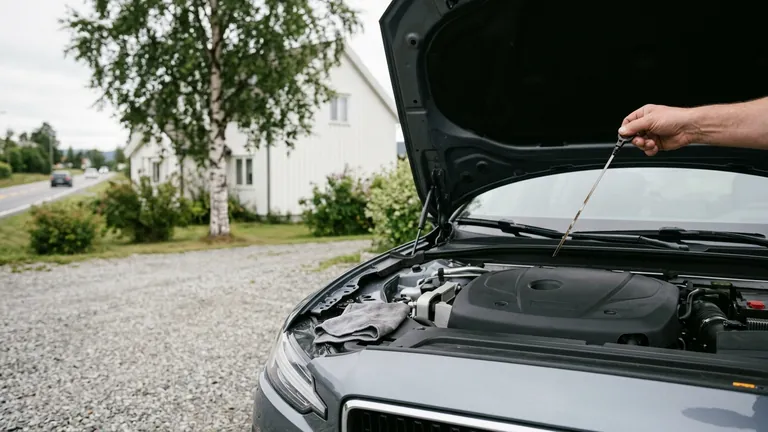
The level must sit between MIN and MAX. Too little oil wears the engine – too much is not good either.
Parts that wear
- Brake pads and discs wear every time you brake and must be replaced at regular intervals.
- Windscreen wipers become stiff and leave streaks – replace them before they fail in rain.
- Tyres wear unevenly if pressure or wheel alignment is incorrect.
- Bulbs and fuses blow now and then – carry spare bulbs if the car uses them.
When the friction lining is gone, metal meets disc. You then have both weaker braking and a costlier repair.
| Part | How wear is noticed | Why it matters |
|---|---|---|
| Brake pads/discs | Scraping sound, vibration, longer pedal or weaker braking | Can reduce braking effect and damage discs |
| Windscreen wipers | Streaks, skipping or rubber separating | Reduces visibility when you need it most |
| Tyres | Uneven wear, cracks or low tread depth | Less grip and greater aquaplaning risk |
| 12V battery | Slow start, electronic faults or many warnings | Can prevent both combustion and electric cars from starting |
Electrics, battery and fuses
- The 12-volt battery runs the starter, lights and electronics. It is charged by the alternator while the engine runs, and it is weakened both by age and by cold.
- If the car has a battery you can open, the fluid level should be between the marks. Top up only with distilled water. Most newer batteries are maintenance-free and should be replaced when they fail.
- Battery acid is corrosive. Use gloves and eye protection, and keep sparks and flames away.
- Fuses protect the electrical system against overload. If one single thing stops working - an indicator or the wipers, say - a blown fuse is a common cause. The handbook shows where the fuse box is and which fuse belongs to what.
- If the same fuse blows again, there is a fault in the circuit. Never fit a heavier fuse to make the problem go away.
Brake fluid: The fluid that transfers force from the brake pedal to the wheel brakes. Absorbs moisture over time and must be replaced according to the manufacturer's schedule.
EU control, registration certificate and approval
For a car to be legal to use, it must be registered, approved and insured, and it must regularly go through an official inspection. This ensures that vehicles on the road maintain a safe technical standard.
EU control (periodic technical inspection)
The EU control is a mandatory technical inspection of brakes, steering, lights, chassis, exhaust emissions and more. You receive notice of the deadline, and the car must be approved by the deadline to be used legally.
The inspection looks at the points that decide whether the car is safe for others, not whether it is well kept.
- An ordinary passenger car is inspected for the first time no later than 4 years after it was registered.
- After that it must be inspected every 2 years.
- You are responsible for the inspection being done by the deadline – if it is not approved in time, the right to use it may be suspended.
First inspection no later than four years after registration, then every two years. The deadline is yours to keep.
| Result | Meaning for you |
|---|---|
| Approved | The car met the inspection requirements on the day of inspection |
| Defects that must be repaired | Faults must be repaired and, if required, rechecked by the deadline |
| Not approved by the deadline | The car may lose its legal right of use until approved |
| Dangerous fault | The car must not be used until the fault is repaired |
Registration certificate and registration
The vehicle registration certificate is the car's identity document. In it you find, among other things, permitted gross weight, how many people may sit in the car, and how heavy a trailer the car may tow. These figures determine what you can legally do with the car.
It is the figures in your own registration certificate that decide how many you may carry and how heavy a trailer you may tow.
| Field in the certificate | What it tells you |
|---|---|
| Permitted gross weight | The highest weight the car may have with driver, passengers and load. |
| Permitted axle load | The highest weight each axle may carry – the load must be distributed correctly. |
| Net weight with driver | The car's weight with no load, but with the driver counted as 75 kg. |
| Permitted payload incl. passengers | How much you may load of people and goods within the gross weight. |
| Permitted combination weight | The highest combined weight of car and trailer together. |
| Permitted trailer weight with brakes | The highest weight for a trailer that has its own brakes. |
| Permitted trailer weight without brakes | The highest weight for a trailer with no brakes of its own – substantially lower. |
| Permitted coupling load | The highest weight the tow hitch may be loaded with. |
| Permitted roof load | The highest weight on the roof, including a roof rack or roof box. |
- Registration number and number plates link the car to an owner.
- The car must have third-party motor insurance to be used.
- If you make a significant change to the car, it may need new approval.
Vehicle registration certificate: The car's official document with technical data such as permitted gross weight, number of seats and maximum permitted trailer weight.