
Class B theory course · chapter 8 of 22
Giving way and right of way
The give-way-to-the-right rule at equal junctions, signed give way and priority roads, and your duty to give way when you turn or drive out of an exit.
The chapter in numbers
- Lessons
- 2about 10 minutes of reading
- Drawings
- 7diagrams and photographs made for the lessons they sit in
- Exam tips
- 3passages that say what the test tends to ask here
- Terms
- 2words explained where they are first used
Why this chapter
Right of way is the topic most people fail on. Not because there are many rules, but because they apply in a fixed order: police, light signals, signs, then the right-hand rule – and it is that order the questions test. This chapter gives you the order, and shows the situations where people most often go wrong.
Written against
The lessons are written against these sources, and the explanations cite them.
- Trafikkreglene § 7
- vegvesen.no
- Trafikkreglene
- skiltforskriften
What the test asks
The practice questions for this chapter belong to one of the seven official themes of the theory test.
The mock-exam split is our own – Statens vegvesen publishes none.
The sign groups in this chapter
Each group has its own page with every sign, its picture and its meaning – free to read.
The lessons, in order
- 1 The give-way-to-the-right ruleThe basic rule for giving way at junctions when no signs or signals say otherwise. 5 min
- 2 Signed give-way duty and priority roadsHow signs override the give-way-to-the-right rule, and what applies when you turn or come from an exit. 5 min
The lessons are part of full access – 149 kr for a week, 199 kr for a month. Chapter 1 is free, so you can see how the course is written first.
All 22 chapters
- 01Introduction
- 02The human in traffic
- 03The car – construction and systems
- 04Checks and maintenance
- 05The road and the traffic environment
- 06The traffic rules and basic duties
- 07Signs, signals and police directions
- 08Giving way and right of way
- 09Observation and communication
- 10Positioning and lane use
- 11Speed, distance and braking distance
- 12Junctions and roundabouts
- 13Overtaking and meeting
- 14Different roads and surroundings
- 15Light and road-surface conditions
- 16Other road users
- 17Stopping and parking
- 18Eco-friendly driving
- 19Load and trailer
- 20The driver's responsibility
- 21At a traffic accident
- 22Risk and attitudes
Read the whole chapter
Full access opens all 22 chapters, mock exams with new questions every time and the sign drill – 149 kr for a week, 199 kr for a month, no automatic renewal.
The give-way-to-the-right rule
At many junctions there are neither signs nor lights. Then the give-way-to-the-right rule applies: you must give way to traffic coming from the right. The rule is simple to state, but it requires you to look early and understand who “right” applies to.
At an equal-status junction, you give way to vehicles coming from the right.
What is an equal-status junction?
How to read the junction before deciding who gives way
- First look for police directions, lights, signs and road markings. They take priority over the right-hand rule.
- Ask whether you are coming from an ordinary road or from an exit, car park, petrol station, farm road or similar. From an exit you give way to everyone.
- Scan to the right early. If a vehicle, cyclist or moped comes from the right at an equal-status junction, you must let it pass.
- Then check the left, oncoming traffic and pedestrians/cyclists who may cross the road you are entering.
- Choose a speed that lets you stop smoothly before the junction without being surprised.
Everyone yields to the one on their right – the order then falls into place by itself.
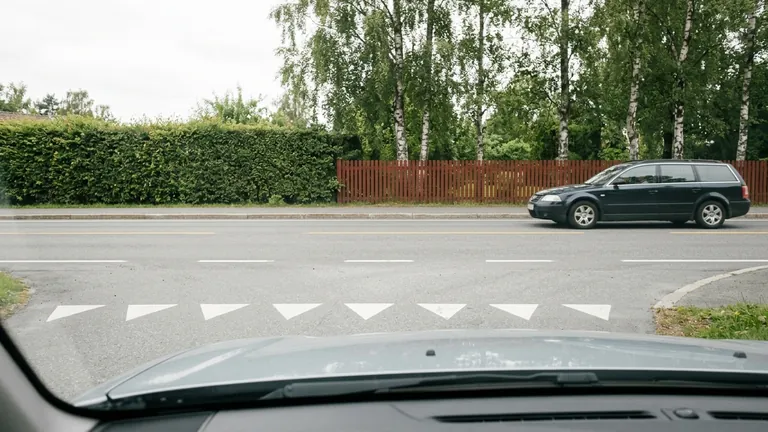
An equal-status junction is a junction without signs, lights or markings that allocate the duty to give way. No road is “more important” than the others, and the give-way-to-the-right rule decides. If you see shark teeth, a give-way sign, a stop sign or a priority-road sign, the junction is not of equal status, and those signs apply instead.
With a sign you give way both ways; at an equal junction, only to the one from the right.
Giving way does not only mean stopping
| Situation | What it means for the right-hand rule |
|---|---|
| Police, traffic lights or arrow lights control the junction | Follow the control. The right-hand rule is not used. |
| A give-way sign, stop sign or shark teeth are placed at your road | You give way to traffic on the road you are entering or crossing. |
| You are driving on a priority road | Side roads must give way, but you must still be ready for mistakes and vulnerable road users. |
| A tram or train crosses | Rail traffic must generally be given clear road; signs may set special rules. |
| You come from an exit or similar area | You give way to all other traffic, not only traffic from the right. |
- Having a duty to give way means that you must not hinder or disturb the other road user.
- You must adapt your speed early, so that you can stop if necessary.
- If you are unsure who should drive, show consideration and let the other road user go first.
The right-hand rule covers more than ordinary junctions
The rule is written as a duty towards vehicles coming from the right, not as a rule about road junctions. It therefore also applies where two directions of travel meet without looking like a junction at all - between the aisles of a large car park, on an open yard, or where two internal roads in an area cross.
Equal-status junction: A junction without signs, lights or markings that allocate the duty to give way. Here the give-way-to-the-right rule applies.
Signed give-way duty and priority roads
Where traffic is denser or visibility is poorer, the duty to give way is allocated with signs. Then the give-way-to-the-right rule no longer applies – you follow the sign. This makes the major roads more predictable and safe.
Common situations with signed give-way duty
A give-way sign means you must let traffic on the crossing road pass, but you do not need to stop if you have full overview and a clearly safe gap. A stop sign means both a full stop and a duty to give way; the wheels must be stationary before you decide whether you can drive.
The triangle lets you roll on into a clear gap; the octagon requires the wheels to stand still.
| Situation | Who gives way |
|---|---|
| You meet a give-way sign or shark teeth | You give way to traffic on the crossing road. |
| You are driving on a priority road | Traffic from side roads gives way to you. |
| You drive out from an exit, car park, pedestrian street or farm road | You give way to all other traffic, including pedestrians and cyclists. |
| You turn left onto a new road | You give way to oncoming traffic that is going straight ahead. |
You cross the pavement first: pedestrians go first, then you give way in both directions.
Turning and giving way
A priority road gives flow, not exemption
- The priority-road sign is the sign that tells you side roads must give way to you.
- The sign is often repeated after junctions, so new road users know they have entered a priority road.
- End of priority road means you can no longer rely on side roads giving way; read the next junction as a new junction.
- Even on a priority road you give way to pedestrians at pedestrian crossings and to pedestrians/cyclists crossing the road you are turning into.
- If you are turning left off a priority road, traffic behind you is a separate risk. Signal before reducing speed and check mirrors several times.
| Sign or situation | Test interpretation |
|---|---|
| Give-way sign | Reduce speed, show that you give way, drive only into a clear gap. |
| Stop sign | Stop completely, reassess, drive only when others are not hindered. |
| Priority-road sign | Side roads give way, but you must still read pedestrian crossings, turns and risk from behind. |
| End of priority road | Expect a new rule at the next junction; the right-hand rule may return. |
| Flashing yellow light | Show special caution; signs apply, otherwise the right-hand rule applies. |
The duty to give way can also be signed where the road becomes too narrow for two vehicles to meet, for example at a narrow bridge. The signs say who must wait, and the colour gives you the answer: the red arrow shows the direction of travel that must give way.
If the red arrow points the way you are driving, you are the one who waits.
When you turn, you may have to give way even if you are actually on the “right” road. If you are turning left, you must let oncoming traffic going straight ahead pass. If you are turning, you also have a duty to give way to pedestrians and cyclists crossing the road you are turning into.
Neither of them is going straight ahead – so the two drivers must agree before they turn.
Give way: A duty to let other traffic pass without hindering or disturbing it. You must adapt your speed so that you can stop if necessary.