
Class A theory course · chapter 9 of 19
Grip, weather and road conditions
Gravel, manhole covers, rails and markings, and how rain, cold, darkness and crosswind hit both the machine and you.
The chapter in numbers
- Lessons
- 3about 16 minutes of reading
- Drawings
- 12diagrams and photographs made for the lessons they sit in
Why this chapter
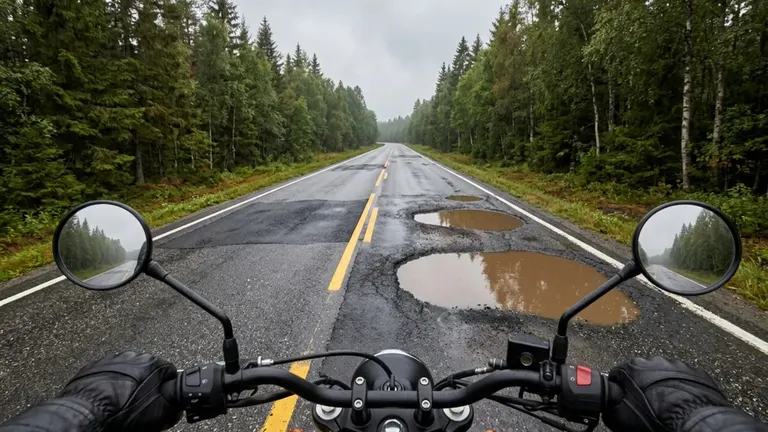
What a car barely notices can put a motorcycle down. This chapter covers the surfaces that steal grip, rain, cold, crosswind and darkness – and why the weather hits both the machine and you as the rider. Norway can give you all of it in a single season, often on a single ride.
Written against
The lessons are written against these sources, and the explanations cite them.
- Læreplan klasse A2 (V850a2) pkt. 2.1.4 og 3.1.3 (fartsavpassing, veggrep)
- trafikkreglene § 13 nr. 1
- læreplan V850a2 trinn 4 (vegdekke – grusveg bør inngå)
- Læreplan klasse A2 (V850a2) pkt. 2.1.4, 2.2.3 og 3.1.4 (kulde og fuktighet)
- Trafikkopplæringsforskriften §§ 8-1, 8-2 og 29-2
- trafikkreglene §§ 13 nr. 1 og 15
- forskrift om bruk av kjøretøy § 1-6
- Læreplan klasse A2 (V850a2) pkt. 1.7 og 3.1.8
What the test asks
The practice questions for this chapter belong to one of the seven official themes of the theory test.
The mock-exam split is our own – Statens vegvesen publishes none.
The lessons, in order
- 1 What the road is made ofGravel, manhole covers, rails, road markings and oil — surfaces a car crosses without noticing, and that put a motorcycle down. 5 min
- 2 Weather, visibility and seasonRain, cold and crosswind — and why weather hits a rider both through the grip and through the rider. 5 min
- 3 Riding in the darkWhy speed belongs to the beam, what a single light does to other people’s distance judgement, and dipping correctly. 6 min
The lessons are part of full access – 139 kr for a week, 199 kr for a month. Chapter 1 is free, so you can see how the course is written first.
All 19 chapters
- 01The motorcycle and the licence
- 02The motorcycle — construction and systems
- 03Clothing and compulsory safety equipment
- 04The motorcycle safety check
- 05Forces, balance and braking
- 06Manoeuvring — low speed, starting and stopping
- 07Positioning and cornering
- 08Observation, where you look, and being seen
- 09Grip, weather and road conditions
- 10Signs, markings and signals
- 11At a traffic accident
- 12The traffic rules and the rider's duties
- 13Motorway, tunnel and level crossing
- 14The rider's and owner's responsibility
- 15Risk, attitudes and riding strategy
- 16Giving way
- 17Speed, distance and overtaking
- 18Environment and consideration
- 19Passenger and load
Read the whole chapter
Full access opens all 19 chapters, mock exams with new questions every time and the sign drill – 139 kr for a week, 199 kr for a month, no automatic renewal.
What the road is made of
A car has four contact patches and enough weight to push through most things. You have two small patches and no reserve. The road surface is therefore not a detail on a motorcycle — it is half the ride.
Where the grip goes
| What | Where you meet it | Why it is dangerous for you |
|---|---|---|
| Gravel and sand | At the outside of bends, at driveways, after winter | Ball bearings under the tyre: grip vanishes suddenly, and usually mid-lean |
| Manhole covers and metal grates | At junctions and in the wheel tracks | Less grip than the asphalt even when dry, very slippery when wet — and they often lie where you turn |
| Rails | City streets with trams, level crossings | A narrow wheel can follow the groove instead of your direction; cross them as close to a right angle as you can within your own lane — the danger is the shallow angle, not missing the last few degrees |
| Road markings | Everywhere | The paint has less grip than the asphalt, and the difference is greatest when it is wet |
| Crack sealant and patches | Repaired cracks and joints, especially on older roads | Glossy strips and patches that turn slippery in heat and in rain |
| Milled asphalt, longitudinal grooves and bridge gratings | Summer roadworks, bridges and expansion joints | The machine "wanders" and feels loose. It is unpleasant but rarely dangerous: loose arms, a steady speed and a straight course. Fighting the bars or braking is what makes it dangerous. |
| Oil and spillage | The centre of the lane, at junctions and roundabouts, and at stops | It collects where vehicles stand and drip — one reason the normal position is not the middle of the lane |
| Wet leaves | In autumn, along the edge and under trees | Wet organic matter forms a slick film between tyre and road surface |
| Frost and ice | Spring and autumn: in shade, on bridges and high up in the mountains | Bridges and shaded stretches freeze before the rest of the road — even when it was above zero where you set off. At +4 °C or below, expect slippery patches — the gauge reads the air, not the road surface |
Gravel washed out across the lane out of a bend — right where you would otherwise be leaning. Seen early, you stand the bike up and roll over it gently.
Manhole covers, gravel and markings: cross them upright, so you spend no grip on turning.
The angle decides everything. A narrow wheel meeting the groove at a slant follows the groove.
Sealant in repaired cracks lies in glossy strips across your line — slippery in heat and in rain, and often mid-bend.
Gravel roads
A gravel road is not a tarmac road with a little gravel on it. Grip is lower everywhere, and it varies across the road: in the wheel tracks the gravel is packed hard; between the tracks and along the edges it lies loose in ridges. The curriculum says gravel roads should be part of the training.
In the track the gravel is packed hard. Between the tracks and along the edge it lies loose — cross the ridge straight and upright.
- Slow down before the change from tarmac, while you still have the grip to brake with.
- Ride in a wheel track, and cross the loose ridge straight and upright when you have to change track.
- Loose arms, knees to the tank. Let the machine move a little under you — a hard grip makes it nervous.
- Do everything smoothly: throttle, brakes and steering. Brake earlier than on tarmac. A front wheel that slides on gravel is seldom caught again.
- Keep a bigger distance. The dust takes your view, and stones from the wheels ahead hit you.
- Meeting traffic: slow down and ease carefully to the right — the edge is often loose and soft.
A city street in the rain: rails at a slant, two manhole covers and painted markings — three slippery surfaces in one lane.
Weather, visibility and season
On a motorcycle the weather has two effects, and the second is easily forgotten. The first is the obvious one: less grip and shorter sight lines. The second is that the weather hits you. If you get cold, wet or dazzled, your reaction time lengthens and your judgement worsens — and it happens gradually enough that you do not notice it yourself.
Rain
The most dangerous rain is the first rain. Water lifts oil and rubber dust that has been lying on the road, and for the first minutes the surface is more slippery than it will be after half an hour of washing. Keep a bigger gap, brake earlier and more gently, and hold the machine more upright through bends.
The most dangerous rain is the first: water lifts the oil out of the asphalt before it washes it away.
The film of oil lifted by the first rain, down the middle of the lane where vehicles have stood and dripped.
Fog
In fog you ride on dipped beam — main beam bounces back off the fog and dazzles you. Fog beads on the visor, outside and in: wipe it while you are stopped, not by riding at speed with the visor up. Your speed must fit the view you have: if you can see 30 metres, you must be able to stop in 30 metres (§ 13 nr. 1). Do not hang on to the tail lights ahead — that only borrows someone else's misjudgement.
Low sun
Low sun ahead dazzles you, and a dirty or scratched visor turns the light into a white wall. With the sun behind you, it is the oncoming driver or the one pulling out of the side road who is dazzled — and you are the narrowest thing in their view. A clean visor, the sun shade down, and less speed where the sun sits right in the road.
Cold
Cold is a safety problem, not a comfort problem. The wind of your own speed chills you far more than the thermometer suggests. Cold hands work the brake less well, cold tyres grip less well, and a rider who is freezing thinks more slowly. Dress for the coldest part of the ride, not for the temperature where you set off.
Crosswind
Wind is a force acting on you all the time, not only in the gusts. A steady crosswind means holding the machine leaned slightly into the wind to keep your line, and that lean spends the same grip that cornering does. Add the load on the bars over time, and you are more tired than the distance would suggest.
In the lee of a lorry you are overtaking, you feel little. The gust arrives the moment you leave it.
Riding in the dark
Riding in the dark is a separate, mandatory part of the basic traffic course, and you must do that part even if you are over 25 and skip the rest of it. On a motorcycle everything that applies to a car applies — plus three things: the machine usually shows only one light from the front, you have no body panel to catch other people’s light, and the cold arrives faster once the sun is gone.
Beyond the beam the road is black. Speed must be such that the stopping distance fits inside the lit part.
How far the light reaches
The figures below are rules of thumb, not measurements of your machine. What matters is how they compare with your stopping distance: on an unlit road, dipped beam reaches less far than your stopping distance from 80 km/h. Then it is not the speed limit that sets your speed — it is the beam.
| What you see | Roughly |
|---|---|
| The road on main beam | 100 m |
| The road on dipped beam | 40 m |
| Dark-clothed pedestrian when meeting | 25 m |
| Pedestrian with a reflector, dipped beam | 140 m |
The stopping distance has to fit inside the beam. On dipped beam at 80 it does not.
One light, not two
A car shows two lights, and the distance between them is what other road users — without thinking about it — use to judge how far away it is and how fast it is coming. If the lights widen quickly, the car is near and closing fast. A motorcycle shows one light, and one light has no width to measure. So you are both spotted later and misjudged: the driver waiting to pull out believes there is more time than there is.
Two lights give a width that grows. One light gives only a point that gets slightly brighter.
Dipping
- Dip as the beams from you and the oncoming vehicle meet on the asphalt. That is the signal — not a set number of metres, which you cannot measure in the dark anyway.
- Do not dip too early. Then both of you ride unnecessarily long on dipped beam and see less far than you need.
- Go back to main beam only once you are alongside the vehicle you are meeting. Your light then points past it.
- When you catch up with someone from behind, dip as soon as your light starts to reach the vehicle in front — otherwise you dazzle the driver through the mirrors.
- When overtaking you may go back to main beam once you are alongside. When you are being overtaken, dip as soon as the other vehicle is ahead of you.
- Meeting a bus or lorry over a crest, dip as soon as you see the marker lights on its roof. The cab sits high, and the driver is dazzled before you see the vehicle itself.
- Main beam must not dazzle any other road user – pedestrians and cyclists included (trafikkreglene § 15 nr. 2). Keep it on as long as no one is dazzled, because you spot them far earlier, and dip in good time once the light reaches them.
Being seen, and seeing, in the dark
Reflective panels on jacket, helmet and bag are protective equipment just as the armour is: they only work when someone shines a light on you, and that is exactly when it matters. A clean visor is the other half. Scratches and grease you never notice by day turn into stars around every light at night, and night vision comes back slowly after each dazzle — far more slowly than eyes adapt to light.
Stopping and parking in the dark
- Get off the carriageway if you possibly can. A motorcycle lying down shows no light towards those approaching.
- Parking lights must be on when you stop or park on a road and the light or visibility conditions make it necessary for the vehicle to be seen. Dipped and main beam must not be on: they dazzle, and they make it harder to see that the vehicle is stationary.
- Not every motorcycle has hazard lights, and a motorcycle is not required to carry a warning triangle. The reflective vest, on the other hand, must be carried — and it goes on when you get off at an emergency stop by the road.
- If you are in a well-lit street where the machine is easy to see anyway, parking lights are not required.