
Class A theory course · chapter 7 of 19
Positioning and cornering
The normal position straight ahead and in a bend, margin of manoeuvre and conspicuity — and why speed is decided before the bend.
The chapter in numbers
- Lessons
- 3about 13 minutes of reading
- Drawings
- 11diagrams and photographs made for the lessons they sit in
- Terms
- 4words explained where they are first used
Why this chapter
Where you place yourself in the lane decides what you see, who sees you and how much room you have when something happens. This chapter explains positioning on the straight and in bends, how to read a bend before you are in it, and why your speed has to be settled before the bend begins. It is the skill that separates a rider who follows the road from one who is surprised by it.
Written against
The lessons are written against these sources, and the explanations cite them.
- Læreplan klasse A2 (V850a2), definisjoner: plassering ved kjøring rett fram, handlingsrom, handlingsberedskap, samhandling
- trafikkreglene §§ 5 nr. 1, 8 nr. 1 og 14 nr. 2, § 6 nr. 2 og § 7 nr. 2 og § 6 nr. 4
- Læreplan klasse A2 (V850a2), definisjoner: normalplassering i sving, svingpunkt, instinktive feilhandlinger
- trafikkreglene § 5 nr. 1
- Læreplan klasse A2 (V850a2) pkt. 3.1.4 og 3.1.7 (presis kjøreteknikk i kurver)
- HB251 læreplan klasse A1/A (2004) pkt. 3.3
What the test asks
The practice questions for this chapter belong to one of the seven official themes of the theory test.
The mock-exam split is our own – Statens vegvesen publishes none.
The lessons, in order
- 1 Positioning on a straightWhy the normal position is slightly left of the centre of your own lane, and what a margin of manoeuvre means. 5 min
- 2 Positioning in a bendMaking the bend gentler than the road is, and why right-hand and left-hand bends carry different risks. 3 min
- 3 Reading the bendThe point where the road edges meet, the bend that tightens, camber and S-bends — everything that decides your entry speed. 5 min
The lessons are part of full access – 139 kr for a week, 199 kr for a month. Chapter 1 is free, so you can see how the course is written first.
All 19 chapters
- 01The motorcycle and the licence
- 02The motorcycle — construction and systems
- 03Clothing and compulsory safety equipment
- 04The motorcycle safety check
- 05Forces, balance and braking
- 06Manoeuvring — low speed, starting and stopping
- 07Positioning and cornering
- 08Observation, where you look, and being seen
- 09Grip, weather and road conditions
- 10Signs, markings and signals
- 11At a traffic accident
- 12The traffic rules and the rider's duties
- 13Motorway, tunnel and level crossing
- 14The rider's and owner's responsibility
- 15Risk, attitudes and riding strategy
- 16Giving way
- 17Speed, distance and overtaking
- 18Environment and consideration
- 19Passenger and load
Read the whole chapter
Full access opens all 19 chapters, mock exams with new questions every time and the sign drill – 139 kr for a week, 199 kr for a month, no automatic renewal.
Positioning on a straight
A motorcycle is narrow, and that gives you something a car driver does not have: you can choose where in the lane you sit. That choice is not arbitrary — it is one of the most important tools you have for being seen and for having somewhere to go.
Slightly left of centre: a view past the vehicle ahead, clear of the oil down the middle.
Slightly left gives you a longer view past the vehicle ahead, and puts you into the mirror and the field of view of the driver in front. At the same time it keeps you away from the centre of the lane, where oil and spillage from other vehicles collect.
Margin of manoeuvre
A margin of manoeuvre is the safety zone you create by keeping distance from anything that could become a problem. The point is not the distance itself but that it buys you time and space to repair a misjudgement — your own or someone else's.
Readiness to act: Preparing an action before it is needed: sharpening your attention, adjusting your seating position, improving your anchor points, covering the brakes or adapting your speed.
Being seen
Conspicuity is both the physical conditions for being seen — the colour of the machine, the clothing and the helmet — and clearly readable actions. If you ride so that others easily grasp what you intend, you are taking their needs into account and seeing the whole picture. That is what the curriculum calls samhandling.
Alongside a car you are in the part of the mirror the driver rarely checks.
One hazard at a time
If you can see that two things will meet exactly where you are — an oncoming lorry and a cyclist on your side, or an oncoming car at a narrowing — you can nearly always choose where it happens. Ease off in good time, so the lorry is past before you reach the cyclist, and you are never squeezed between them. Speed is the tool that moves the meeting point.
Two hazards at once leave no escape route. Ease off, and they become two simple situations, one after the other.
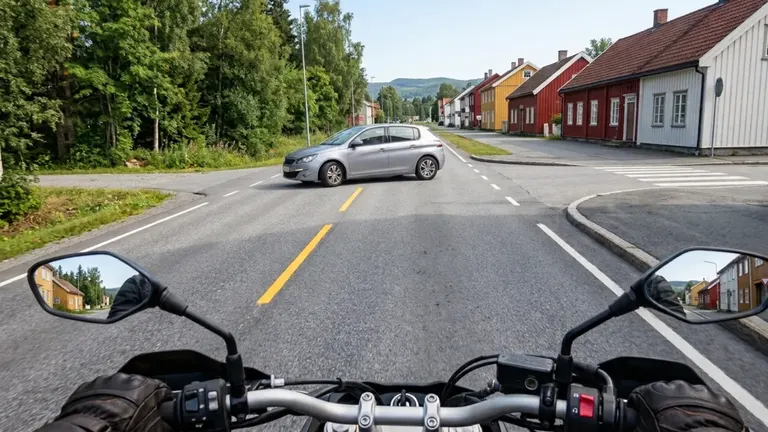
Turning at a junction
The normal position is for going straight. When you turn, trafikkreglene § 6 nr. 2 says where to be: for a right turn, as close to the right edge of the carriageway as possible; on a two-way carriageway, for a left turn, as close to the middle as possible. Move in good time, with mirror, shoulder check and signal, so your position says the same as your indicator.
- Right turn: do not leave a gap on your right that a cyclist or moped can take. The turn is tight, so speed and gear are settled before you start to turn.
- Left turn: wait with the front wheel pointing straight, not turned into the turn. If you are hit from behind while waiting, you are pushed straight ahead and not out in front of the oncoming traffic — which you must give way to (§ 7 nr. 2).
- If an oncoming vehicle is also turning left, you may turn left of each other (§ 6 nr. 4) — follow the markings where there are any. If you turn in front of each other, the oncoming vehicle hides the traffic behind it from you, and you from it. Wait until you can see past.
- Do not cut the corner of a left turn. You must end up in the right lane of the road you turn into, and a car waiting there may sit closer to the middle than you think.
- From a standstill straight into a turn: look where you are going before you release the clutch, and do not use the front brake with the bars turned — the machine falls inwards.
Turning right: in towards the right edge. Turning left: in towards the middle, and wait with the front wheel straight.
When the normal position does not fit
- Oncoming heavy vehicles, or poor sight over a crest or round a bend: move towards the right of the lane, away from the middle of the road.
- Junctions and driveways on the right, or parked cars where a door may open: keep more room on the right, so you are both seen and have time.
- Potholes, gravel, manhole covers or oil: ride where the surface is best, and move in good time.
- Behind a car or a larger vehicle: where the driver sees you in the mirror and you can see past — not straight behind in the middle of the lane.
Positioning in a bend
Safe cornering depends on the right position, the right speed, the right steering technique — and on both machine and rider staying within their own lane. The last is a rule as well: the vehicle must be kept well within its lane. The position is chosen to give the best possible margin of manoeuvre.
Right-hand bend
The risk in a right-hand bend is ending up in the oncoming lane. To get the greatest margin you normally position yourself in the left part of your lane well before the bend begins, and are to the right of the lane's centre around the middle of the curve.
In on the left of your own lane, right of its centre at the apex, and out again — all inside one lane.
Left-hand bend
The risk in a left-hand bend is running off the road, or failing to keep enough margin because you have set up too large a radius. To get the greatest margin you normally position yourself next to the edge line in your own lane well before the bend — with a margin to gravel and the road edge — and then continue towards a point left of the centre of your own lane.
In at the edge line, then towards the left of the lane centre. The risk here is the verge, not the oncoming lane.
Turn point: The point on the road where the motorcycle begins to turn as a result of the countersteering input. Speed, gear and position should all be settled before you reach it.
When a bend tightens on you, the answer is nearly always more lean — not the brakes and an upright machine.
Reading the bend
Position solves only half the bend. The other half is reading it before you are in it: how tight it is, whether it tightens further, how the surface slopes and whether another bend follows immediately. Curve type, road surface, camber and how the road runs on all end in one and the same decision: the speed you enter with.
The point where the edges meet
Look at the furthest point ahead where the two edges of the road appear to meet. That point is the limit of your sight, and it moves as you approach. It is the cheapest information you will get about a bend you have never ridden before.
- If the point moves away from you as you approach, the bend is opening. Your speed is right, and you can start to open the throttle.
- If the point stands still, the bend is constant. Hold your speed.
- If the point comes towards you, the bend is tightening. Speed must come down now, while the machine is still upright.
The point where the edges meet is a speedometer: it moves away, stands still, or comes towards you.
Three types of curve
- Constant radius: the same sharpness throughout. The speed you set at the entry holds all the way through.
- Increasing radius: it opens out towards the end. It forgives the most, and it tempts you into the next one too fast.
- Decreasing radius: it tightens towards the end, and it is the one that catches most riders. What you see at the entry does not tell you how sharp it ends up.
The bend that tightens
A constant-radius bend forgives a slightly high entry speed. A tightening one does not. Enter a tightening bend too fast and you must either lean more or brake — and in mid-lean you have grip to spare for neither. That is why this curve type accounts for so many rural run-offs, and why margin on the way in is cheaper than technique on the way out.
The same entry, two different bends. The tightening one demands the speed you can no longer get rid of.
Camber
The surface is rarely level across the road. If the bend is built sloping in towards the inside, the road helps you: part of the cornering force is taken by the surface itself, and you need less lean for the same speed. If the slope runs the other way — common at junctions, at accesses and in bends laid out to follow the terrain — the road steals grip instead of giving it. Adverse camber together with a wet, dirty or cold surface is the combination that puts most machines down.
A slope inwards takes part of the cornering force. A slope outwards puts it back on the tyres.
S-bends
Two bends that run into each other are not solved one at a time. Ride the first one all the way out to the edge, as that bend alone would suggest, and you arrive on the wrong side of the lane for the entry to the second — which then has to be ridden tighter than it really is. Set the first bend up for where you need to be when the second one starts. Often that means giving up part of the first.
The first bend is given up for the second. The line through the first is set for where you must be when the second begins.
The surface in the bend
- The wheel tracks are polished and hold water; down the middle of the lane lie oil and rubber dust from vehicles that have stood still.
- Gravel and sand collect along the edges and where water runs across the road — both are places you may end up using in a bend.
- Patches, joints, manhole covers and markings grip less than the asphalt around them, and the difference is first felt when the machine is already leaned over.
- In the shade of rock and trees the road dries last and freezes first. The same bend can have two different surfaces on either side of a rock cutting.
Optical guidelines: Edge lines, guardrails, snow poles and lines of trees that show where the road runs on before you can see the carriageway itself.
Camber: The slope of the surface across the direction of travel. Sloping in towards the inside of the bend it helps you; sloping outwards it steals grip.