
Class A theory course · chapter 3 of 19
Clothing and compulsory safety equipment
The helmet rule, what your clothing must withstand, and why clothing is the passive safety on two wheels.
The chapter in numbers
- Lessons
- 2about 5 minutes of reading
- Drawings
- 3diagrams and photographs made for the lessons they sit in
- Terms
- 1words explained where they are first used
Why this chapter
On a motorcycle there is no bodywork around you – what you wear is what protects you. This chapter covers the helmet rule and what counts as approved, what your clothing must be able to withstand, and why choosing what to wear is a safety decision, not a matter of style.
Written against
The lessons are written against these sources, and the explanations cite them.
- Forskrift om bruk av personlig verneutstyr under kjøring med motorvogn §§ 2 og 3, jf. vegtrafikkloven § 23a
- Læreplan klasse A2 (V850a2) pkt. 2.1.6 og 2.2.3
- trafikkopplæringsforskriften § 4-9
What the test asks
The practice questions for this chapter belong to 2 of the seven official themes of the theory test.
- Driver & owner responsibility154 practice questions · 4 of 40 in our mock exam
- Driver & other road users176 practice questions · 5 of 40 in our mock exam
The mock-exam split is our own – Statens vegvesen publishes none.
The lessons, in order
- 1 The compulsory crash helmetWho the helmet rule binds, what counts as approved, and the few exemptions. 2 min
- 2 Clothing that protectsOn a motorcycle your clothing is the passive safety — there is no bodywork, no seat belt and no cabin around you. 3 min
The lessons are part of full access – 139 kr for a week, 199 kr for a month. Chapter 1 is free, so you can see how the course is written first.
All 19 chapters
- 01The motorcycle and the licence
- 02The motorcycle — construction and systems
- 03Clothing and compulsory safety equipment
- 04The motorcycle safety check
- 05Forces, balance and braking
- 06Manoeuvring — low speed, starting and stopping
- 07Positioning and cornering
- 08Observation, where you look, and being seen
- 09Grip, weather and road conditions
- 10Signs, markings and signals
- 11At a traffic accident
- 12The traffic rules and the rider's duties
- 13Motorway, tunnel and level crossing
- 14The rider's and owner's responsibility
- 15Risk, attitudes and riding strategy
- 16Giving way
- 17Speed, distance and overtaking
- 18Environment and consideration
- 19Passenger and load
Read the whole chapter
Full access opens all 19 chapters, mock exams with new questions every time and the sign drill – 139 kr for a week, 199 kr for a month, no automatic renewal.
The compulsory crash helmet
The helmet requirement is set out in the regulation on the use of personal protective equipment when driving a motor vehicle. The wording is short and wide: everyone must wear an approved crash helmet when riding a snowmobile, a two- or three-wheeled motor vehicle (four-wheeled motorcycles included), in a sidecar to a two-wheeled motorcycle, and in a sledge behind a snowmobile.
Approved, and fastened
The helmet must be approved. Approved helmets are marked to UN ECE Regulation 22 — a label with an E in a circle, usually sewn onto the chin strap. A helmet that is not fastened offers no protection: it leaves your head at the moment you need it. A helmet that has taken an impact must be replaced even if it looks intact — the foam inside is designed to deform once.
Fastened, correctly fitted, and replaced after an impact — three requirements, not one.
- It must sit firmly without pinching, and must not roll off forwards with the strap fastened.
- The visor or goggles must be clear and clean — scratches and misting cost you vision exactly when speed is high.
- If the helmet has been through a fall or dropped hard on the ground, treat it as used up. Damage to the foam does not show on the outside.
The exemptions
The exemptions are few. The requirement does not apply while the vehicle is stationary, nor when riding in a garage, a car park, a filling station, a workshop area or a similar enclosed area. The rest are narrow: three- and four-wheelers with a closed body and seat belts, certain work with a snowmobile, and military units using the armed forces’ helmet.
Clothing that protects
A car protects its driver with bodywork, crumple zones, a seat belt and airbags. None of that exists on a motorcycle. What the curriculum calls "limited passive safety" means, in practice, that what you are wearing is the only thing between you and the asphalt.
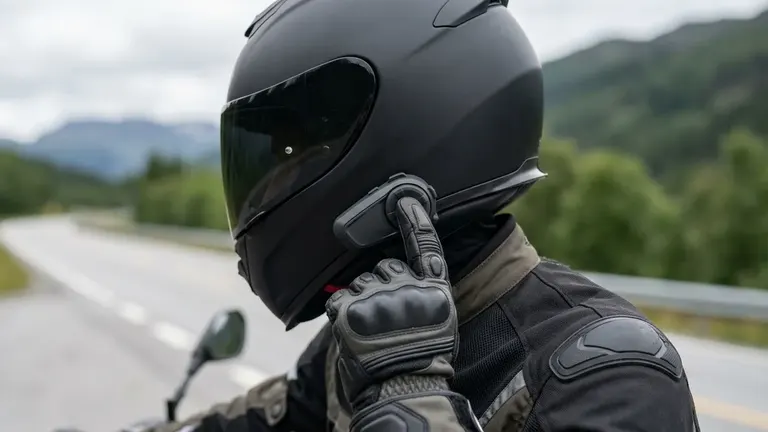
Helmet with the visor down, jacket and trousers with armour, gloves that cover the wrist, and boots over the ankle.
What the equipment must withstand
Motorcycle clothing has two jobs: it must not give way while you slide along the road, and it must absorb impact where the body lands first. The material therefore matters as much as the fit.
Every item has a job. The sum of them is your passive safety.
- A jacket and trousers covering the whole body, in a material that will not melt, burn or tear open.
- Gloves that cover the wrist. In a fall you put your hands out, and that is a reflex you cannot train away.
- Footwear covering the ankle and giving support — not trainers.
- Armour where the body lands: a back protector, and shoulder, elbow and knee protectors.
- An airbag vest, which deploys in a fall and protects neck, back and chest. It is not compulsory, but the curriculum names it.
Being seen is protective equipment too
When a motorcycle and a car collide, one of the commonest explanations is that the driver did not spot the rider in time. The colour of your clothing and helmet, and of the machine itself, is therefore not decoration — it is part of your safety, together with your position on the road and a clearly readable riding style.
Noise is an injury too
Under the helmet it is not the engine that is loudest — it is the wind. At main-road speeds the noise level inside a helmet is high enough that long rides cause permanent hearing loss, and hearing loss does not come back. Earplugs made for riding damp the wind roar most where it is worst and still let you hear sirens, horns and the engines around you. Many riders also find they tire less on a long day.
Passive safety: What protects you once a crash happens, as opposed to active safety, which is meant to prevent one. On a motorcycle, passive safety is essentially what you are wearing.