
Class A theory course · chapter 2 of 19
The motorcycle — construction and systems
Engine, transmission, frame and suspension, and why the front brake and two small contact patches decide most of it.
The chapter in numbers
- Lessons
- 4about 14 minutes of reading
- Drawings
- 9diagrams and photographs made for the lessons they sit in
- Exam tips
- 2passages that say what the test tends to ask here
- Terms
- 2words explained where they are first used
Why this chapter
You do not need to be a mechanic, but you must understand what makes a motorcycle go, stop and turn – and why it behaves so differently from anything on four wheels. Engine and transmission, frame and suspension, brakes and tyres, the controls – and the sidecar outfits and multi-wheeled machines your licence also covers: this chapter gives you what you need to answer correctly and ride safely.
Written against
The lessons are written against these sources, and the explanations cite them.
- Læreplan klasse A2 (V850a2) pkt. 2.1.4 og 2.2.1
- forskrift om bruk av kjøretøy
- forskrift om bruk av kjøretøy § 1-4
- Læreplan klasse A2 (V850a2) pkt. 2.2.1 og 2.2.4
- instruksjonsboka for kjøretøyet
- Læreplan klasse A2 (V850a2) pkt. 2.2.1
- trafikkreglene § 5 nr. 2
- forskrift om bruk av personlig verneutstyr under kjøring med motorvogn § 2
What the test asks
The practice questions for this chapter belong to one of the seven official themes of the theory test.
The mock-exam split is our own – Statens vegvesen publishes none.
The lessons, in order
- 1 The motorcycle's main systemsEngine, transmission, frame, forks, swingarm and suspension — and why a two-wheeler behaves the way it does. 3 min
- 2 Brakes, wheels and tyresWhy the front brake does most of the work, what ABS does and does not do, and what the rules require of your tyres. 4 min
- 3 Controls, the cut-off switch and the fuel tapThe controls you work the machine with — including the two a car driver has never touched. 4 min
- 4 Sidecars and three- and four-wheeled motorcyclesVehicles your licence covers that do not behave like a two-wheeler at all. 3 min
The lessons are part of full access – 139 kr for a week, 199 kr for a month. Chapter 1 is free, so you can see how the course is written first.
All 19 chapters
- 01The motorcycle and the licence
- 02The motorcycle — construction and systems
- 03Clothing and compulsory safety equipment
- 04The motorcycle safety check
- 05Forces, balance and braking
- 06Manoeuvring — low speed, starting and stopping
- 07Positioning and cornering
- 08Observation, where you look, and being seen
- 09Grip, weather and road conditions
- 10Signs, markings and signals
- 11At a traffic accident
- 12The traffic rules and the rider's duties
- 13Motorway, tunnel and level crossing
- 14The rider's and owner's responsibility
- 15Risk, attitudes and riding strategy
- 16Giving way
- 17Speed, distance and overtaking
- 18Environment and consideration
- 19Passenger and load
Read the whole chapter
Full access opens all 19 chapters, mock exams with new questions every time and the sign drill – 139 kr for a week, 199 kr for a month, no automatic renewal.
The motorcycle's main systems
You do not need to be a mechanic to get your licence, but you do need to know enough about the machine to notice something is wrong before it becomes dangerous. On two wheels there is no reserve: if a tyre, a brake or the steering fails, you have no second pair of wheels to carry you.
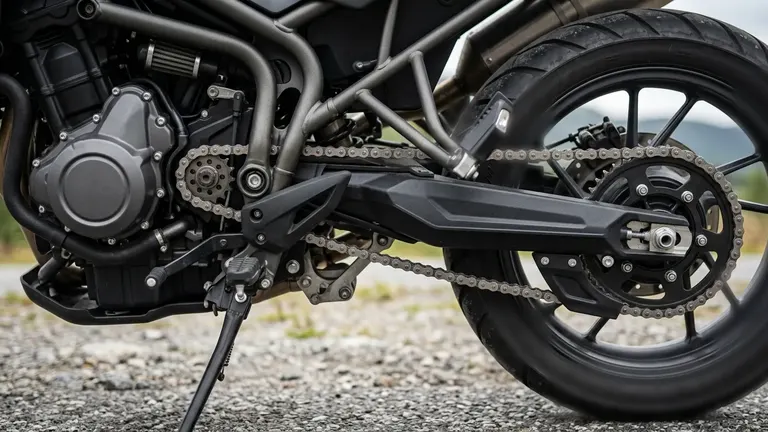
The parts you are responsible for recognising and checking, on one machine.
From engine to rear wheel
The engine drives the rear wheel through the clutch, gearbox and a final drive. That last part comes in three forms, and they need different care.
- Chain — the most common, the lightest, but it must be tensioned and lubricated regularly. A slack or dry chain wears quickly and at worst can jump off.
- Belt — runs cleaner and needs less attention, but must be replaced at a set interval.
- Shaft — enclosed and almost maintenance-free, but heavier, and its oil is changed to the manufacturer's schedule.
Three kinds of final drive — and three different kinds of upkeep.
Frame, forks and swingarm
The frame holds everything together. The forks carry the front wheel and absorb shocks at the front; the swingarm does the same at the rear. Together with the springs and dampers they decide how steadily the wheels follow the road surface — and therefore how much grip you actually have.
Directional stability
A motorcycle in motion stays upright by itself. That comes from the interaction of the wheels’ rotation, the centre of gravity and the geometry at the front: how far the forks are raked, and how far behind the point where the steering axis meets the ground the front tyre touches down. This self-stability is why the machine "wants" to straighten up, and why it becomes harder to lay over the faster you go.
The steering axis meets the ground ahead of the contact patch. That trail is what straightens the wheel.
Trail: The distance between where the steering axis meets the ground and where the front wheel actually touches it. Trail is what makes the front wheel seek straight ahead, the way a castor lines itself up with the direction of travel.
Brakes, wheels and tyres
A motorcycle has two brakes you operate separately: the lever for the front and the pedal for the rear. Their being separate is not a drawback — it is what lets you distribute braking to suit the situation.
Weight shifts forward
When you brake, weight is thrown forward. The front wheel is pressed into the road and gains grip, while the rear becomes light and loses it. That is why the front brake provides most of the braking effect, and why the rear wheel locks so easily if you stamp on the pedal. How much of the braking sits at the front varies with the type of machine and with how hard you are braking.
ABS and linked brakes
ABS stops the wheel locking under braking, so you can brake hard and still steer. Some machines have linked brakes, where one control acts on both wheels. Ordinary ABS is designed for braking with the machine upright; some newer machines have cornering ABS, which tolerates some lean. None of it makes the stopping distance shorter than the grip allows.
The tyres
A motorcycle's two contact patches with the road are together about the size of two palms. Everything you do — accelerate, brake, turn — goes through them. Air pressure, tread depth and the tyre's condition are therefore not details but the things that decide whether the machine does what you ask of it.
Two narrow patches on the road, and they move sideways across the tyre as you lean.
Tread depth is measured in the main grooves across the middle of the tread. The wear indicator at the bottom of the groove marks 1.6 mm.
| Requirement | Motorcycle |
|---|---|
| Minimum tread depth, summer | 1.6 mm |
| Minimum tread depth, in the winter period | 3 mm |
| The winter period | 1 November to the first Sunday after Easter Monday; 16 October–30 April in Nordland, Troms and Finnmark |
| Where depth is measured | In the main grooves across the middle ¾ of the tread, all the way round — not on the wear indicators |
| Studded tyres | Allowed in the winter season, but then on both wheels |
| Air pressure | As the manufacturer specifies — in the owner’s manual, often on the machine too |
A motorcycle tyre is rounded in profile, not flat like a car's. That means the rolling circumference shrinks as you lean: the machine is rolling on a narrower part of the tyre, and it is one reason the throttle must be adjusted through a bend.
Contact patch: The part of the tyre touching the road at any moment. On a motorcycle it is small, and it moves sideways across the tyre as you lean.
Controls, the cut-off switch and the fuel tap
In a car everything you operate is within reach of two hands and two feet, and you can let go of all of it without consequence. On a motorcycle both hands and both feet are in use the whole time, and two of the controls do not exist in a car at all.
Hands and feet
- Right hand: the throttle and the front brake lever.
- Left hand: the clutch lever.
- Right foot: the rear brake pedal.
- Left foot: the gear lever.
The cut-off switch sits within thumb reach, so you can use it without letting go of the bars.
The cut-off switch is the red rocker on the right-hand switch housing, within thumb reach without letting go of the throttle grip.
Set the machine up for you
The controls are set by the factory to an average, not to you. The curriculum counts setting them up as part of preparing to ride, and it is done once — not on the move.
- The mirrors should show the road behind you, not your shoulders. Sit in your riding position while you adjust them.
- The brake and clutch levers can usually be angled, and on many machines adjusted for reach. The right angle gives a straight line from forearm through wrist when you brake.
- The gear lever and rear brake pedal must be reachable without lifting your foot off the footrest.
- Sit so that you can reach every control without stretching or shifting in the seat, and so that you can reach the ground with at least one foot when you stop.
The engine cut-off switch
The cut-off switch sits on the handlebar and stops the engine without you letting go. It exists because the situations where you have to kill the engine — a throttle that sticks open, a fall, a leak — are the ones where you have neither the time nor a free hand to go looking for the ignition key.
The fuel tap and the reserve
Older machines have a fuel tap with on, off and reserve positions. If the engine starves, the reserve is the last litres in the tank — enough to reach a filling station, not enough to postpone filling up. Newer machines have a fuel pump and no tap, and warn with a lamp or a gauge instead.
Ignition, steering lock and side-stand cut-out
The ignition switch cuts the power, and on most machines it also locks the steering if you first turn the bars fully to one side. The side-stand cut-out stops the engine, or prevents it starting in gear, while the stand is down. All three are part of the vehicle, and all three have to work.
Sidecars and three- and four-wheeled motorcycles
The læreplan names sidecars and three- and four-wheeled motorcycles specifically under the construction of the machine. The reason is that everything you have learned about leaning and countersteering stops applying the moment a third wheel appears at the side.
A sidecar outfit does not lean. It is steered, and it turns differently to the right and to the left.
Sidecars
- The outfit does not lean. You turn by steering the bars the way you want to go, as you would a car — countersteering does not work here.
- It is asymmetric, so right and left turns are two different manoeuvres. With the sidecar on the right, the sidecar wheel can lift in a fast right-hand turn, and in a fast left-hand turn it can be the motorcycle’s wheels that go light.
- It is wider than you are used to, and all the width is on one side. That side is easy to forget in a narrow gap.
- Throttle and brakes pull the outfit sideways. With the sidecar on the right it pulls to the right when you accelerate, and to the left when you brake — unless the sidecar has a brake of its own.
The outfit stays upright — it does not lean, not even in a bend. The sidecar is on the right, and all the extra width is on that one side.
Three- and four-wheeled motorcycles
There are motorcycles with two wheels at the front and one at the back, and four-wheeled motorcycles. They are ridden with handlebars and share much of a motorcycle’s controls, but their weight and track give them quite different behaviour in a bend and under braking than a two-wheeler. The exception is the three-wheeler with two close-set front wheels that leans: it is laid over and countersteered exactly like a two-wheeler, and what sets it apart is its stability at low speed and under braking. It is still not a two-wheeler, though — so the bus-lane exception does not cover it either.