
Class A theory course · chapter 8 of 19
Observation, where you look, and being seen
Why others overlook a motorcycle even having looked at it, head position in a bend, mirrors and shoulder checks, and the riding process.
The chapter in numbers
- Lessons
- 2about 8 minutes of reading
- Drawings
- 4diagrams and photographs made for the lessons they sit in
- Terms
- 2words explained where they are first used
Why this chapter
The most dangerous sentence in traffic is "I didn't see you" – and on a motorcycle it is you who pays for it. This chapter covers why others overlook a motorcycle, where your eyes should be, mirrors and shoulder checks, and how to make yourself visible and predictable. These are skills the practical test measures directly, and the theory test asks why they work.
Written against
The lessons are written against these sources, and the explanations cite them.
- Læreplan klasse A2 (V850a2) pkt. 2.1.3 og 2.1.5
- trafikkopplæringsforskriften § 9-4 nr. 7
- Læreplan klasse A2 (V850a2) pkt. 2.1.3, 2.2.3 og 3.1.4
- trafikkreglene § 8 nr. 1 og § 14 nr. 2
What the test asks
The practice questions for this chapter belong to one of the seven official themes of the theory test.
The mock-exam split is our own – Statens vegvesen publishes none.
The lessons, in order
- 1 Being overlookedWhy other road users overlook a motorcycle — even when they have looked straight at it — and what you can do about it. 4 min
- 2 Where you look, and what you take inHead position in a bend, where your eyes should be, mirrors and shoulder checks — and why you ride where you look. 4 min
The lessons are part of full access – 139 kr for a week, 199 kr for a month. Chapter 1 is free, so you can see how the course is written first.
All 19 chapters
- 01The motorcycle and the licence
- 02The motorcycle — construction and systems
- 03Clothing and compulsory safety equipment
- 04The motorcycle safety check
- 05Forces, balance and braking
- 06Manoeuvring — low speed, starting and stopping
- 07Positioning and cornering
- 08Observation, where you look, and being seen
- 09Grip, weather and road conditions
- 10Signs, markings and signals
- 11At a traffic accident
- 12The traffic rules and the rider's duties
- 13Motorway, tunnel and level crossing
- 14The rider's and owner's responsibility
- 15Risk, attitudes and riding strategy
- 16Giving way
- 17Speed, distance and overtaking
- 18Environment and consideration
- 19Passenger and load
Read the whole chapter
Full access opens all 19 chapters, mock exams with new questions every time and the sign drill – 139 kr for a week, 199 kr for a month, no automatic renewal.
Being overlooked
The conflict points between motorcyclists and other road users are a topic of their own in the curriculum, and with good reason. Head-on and run-off crashes on rural roads are among the most serious, and chapter 7 deals with them. When a motorcycle and a car collide at a junction, the pattern is often the same: a car turns left across an oncoming motorcycle, or pulls out of a side road — and the driver says afterwards that they did not see it.
Why they do not see you
It is rarely ill will. It is how vision works. A driver checking for "a car" is looking for a wide, familiar shape. A motorcycle is narrow, covers a small part of the field of view, and can be hidden behind a windscreen pillar, a mirror or another vehicle in the half-second the driver looks that way.
From a car’s driving seat, the pillar covers exactly the piece of road a motorcycle arrives in.
The car doubles in the field of view. So does the motorcycle — but from so little that the change hardly registers.
What you can do about it
- Position yourself where you are in the field of view of anyone who might cross — not behind another vehicle and not in a mirror's blind spot.
- Assume that a driver who could turn across you will. Be ready to act into every junction and every driveway.
- Eye contact is no guarantee. A driver can look straight at you and still not register you — or register you as far away. Cover the brakes, hold a steady speed and a clear position, and be ready to brake hard in a straight line. Sudden changes of speed or position can be read as you getting ready to turn.
- Use colours and lights that separate you from the background, and ride clearly enough that others can read your intention.
- Adapt your speed where sight lines are short. If you are spotted late, speed is what decides how it ends.
Large vehicles
A lorry or an articulated vehicle is not simply a bigger car. The driver sits high and sees you only in the mirrors, the vehicle is long enough that the rear wheels do not follow the front ones, and it takes up room it does not look as though it needs until it starts to turn.
- If you cannot see the driver’s mirrors, the driver cannot see you. It is the simplest following-distance rule there is behind a large vehicle.
- A long vehicle swings the opposite way before it turns. Turning right, it first goes left — and the space that opens on its right is not a lane, it is where the rear wheels are going.
- Never ride up alongside a large vehicle that is indicating, however much room there looks to be.
- Keep extra distance in the rain: spray off the wheels takes your view long before you are close enough to do anything about it.
- If there is a load on the bed, stay far enough back to react to what comes off it.
The space that opens on the inside is not yours — it is where the rear wheels are going.
Where you look, and what you take in
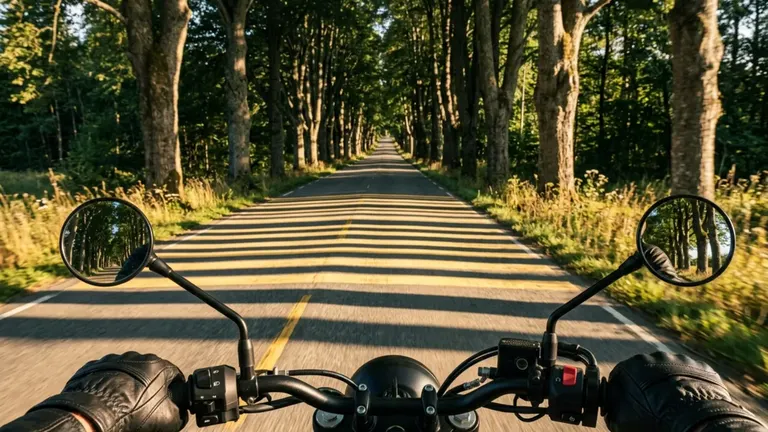
The curriculum mentions head position in bends specifically. The reason is that on a motorcycle your gaze does not only gather information — it steers. Look far ahead through the bend and the machine follows. Fix your eyes on the gravel at the outer edge and that is where you will go.
On two wheels the gaze does not only gather information — it steers.
Keep your eyes moving
- Far ahead, near, to the sides and in the mirrors — in a steady round, not staring at one point. The curriculum calls it basic scanning technique.
- Far ahead means roughly 10–12 seconds: the place you will be in 12 seconds is what you should be reading now. At 80 km/h that is more than 250 metres. Whatever is closer than 4 seconds is what you must be ready to brake or steer for.
- Check the mirrors before you brake, before you move within the lane and before you turn — and otherwise often enough that you always know what is behind you.
- Before changing lane or moving sideways: a shoulder check into the blind spot. The mirrors do not cover it, and you must give way to anyone already there.
- Signal in good time, and cancel the indicator afterwards. Many motorcycles do not cancel it for you, and an indicator left on can trick a driver into pulling out in front of you.
Sharp vision and peripheral vision
Only a small patch in the middle of your view is sharp — about a thumbnail at arm's length. The rest is peripheral vision: blurred, but good at spotting movement. It tells you something is there, not what it is, so you have to move your eyes to it. The faster you ride, the further ahead your gaze locks, and the narrower the part of your view you actually use: the car in the side road and the child at the kerb slide out to the edge. Where a lot is happening at the sides, lower speed is the only thing that gives you your field of view back.
The riding process
Riding is a chain: you gather information, process it, decide and act. The chain takes time, and that time is your reaction time. If you are tired, stressed, cold or overloaded with impressions, every link slows — and on a motorcycle you have less to spare when that happens.
That is why step 2 is built the way it is: you must master handling the machine well enough that your attention can move from the motorcycle to the traffic around you. As long as you have to think about gear changes and balance, you have no attention left for what is coming from the side.
Riding strategy: The plan for the ride: a short or a long trip, what may happen along the way, and how you will carry it out. Your own strengths and weaknesses, the weather and road conditions and the traffic all feed into it.
Riding tactics: The choices you make along the way from the situation as it is right now: "do I ride here as I planned, or is there a safer choice given how things look now?"