
Class A theory course · chapter 4 of 19
The motorcycle safety check
The points the rider is responsible for, the shape of the task at the test, the warning lamps and the emergency stop, and what you do when something fails under way.
The chapter in numbers
- Lessons
- 3about 10 minutes of reading
- Drawings
- 3diagrams and photographs made for the lessons they sit in
- Exam tips
- 2passages that say what the test tends to ask here
- Terms
- 2words explained where they are first used
Why this chapter
The rider is responsible for the motorcycle being in a safe condition – and on two wheels a fault has consequences sooner. This chapter walks you through the points you should be able to check yourself, what the warning lamps are trying to tell you, and what to do when something fails under way. It is also the foundation for the safety check on the practical test.
Written against
The lessons are written against these sources, and the explanations cite them.
- Læreplan klasse A2 (V850a2) pkt. 2.2.7 og kommentarene til trinn 2
- forskrift om bruk av kjøretøy
- Læreplan klasse A2 (V850a2) pkt. 2.2.7
- forskrift om bruk av kjøretøy § 1-6
- instruksjonsboka for kjøretøyet
- Læreplan klasse A2 (V850a2) pkt. 2.2.1 og 2.2.7
What the test asks
The practice questions for this chapter belong to 2 of the seven official themes of the theory test.
- The vehicle207 practice questions · 5 of 40 in our mock exam
- Driver & owner responsibility154 practice questions · 4 of 40 in our mock exam
The mock-exam split is our own – Statens vegvesen publishes none.
The lessons, in order
- 1 What you must be able to checkThe points the rider is responsible for, and the shape the task takes at the test: show it, and say why it matters. 4 min
- 2 Reliability and warning lampsOil, fuel and what the instrument panel is trying to tell you — and why a breakdown is more dangerous on a motorcycle. 2 min
- 3 When something fails under wayA puncture, a stuck throttle, a chain or belt that breaks, and a weave — what happens, and what you do while it is happening. 4 min
The lessons are part of full access – 139 kr for a week, 199 kr for a month. Chapter 1 is free, so you can see how the course is written first.
All 19 chapters
- 01The motorcycle and the licence
- 02The motorcycle — construction and systems
- 03Clothing and compulsory safety equipment
- 04The motorcycle safety check
- 05Forces, balance and braking
- 06Manoeuvring — low speed, starting and stopping
- 07Positioning and cornering
- 08Observation, where you look, and being seen
- 09Grip, weather and road conditions
- 10Signs, markings and signals
- 11At a traffic accident
- 12The traffic rules and the rider's duties
- 13Motorway, tunnel and level crossing
- 14The rider's and owner's responsibility
- 15Risk, attitudes and riding strategy
- 16Giving way
- 17Speed, distance and overtaking
- 18Environment and consideration
- 19Passenger and load
Read the whole chapter
Full access opens all 19 chapters, mock exams with new questions every time and the sign drill – 139 kr for a week, 199 kr for a month, no automatic renewal.
What you must be able to check
The safety check is not a list you recite. At the practical test you are given a task that almost always has a practical element and a follow-up question: you must show that you can judge whether something is in order, and say something about the cause of a fault or what it leads to.
The control points where they live. The table below says what you look for at each.
The points
The curriculum lists the check points below. They cover what the rules make the rider responsible for — not everything a mechanic would look at.
| Point | What you look for |
|---|---|
| Wheels and tyres | Tread depth, pressure (measured cold, before the ride), damage to the sidewall, that the tyre is seated correctly and that nothing is lodged in the tread |
| Front and rear brake | That each works separately, that the lever and pedal have normal travel, and that nothing leaks |
| Final drive | Chain tension and lubrication, or the belt’s condition, or the oil level on a shaft drive |
| Suspension and dampers | That they spring and damp, that no oil is leaking, and that the machine does not keep bouncing after you press it down |
| Steering and forks | That the bars move freely from side to side without catching or free play — and that the throttle snaps shut by itself when released, also with the bars at full lock either way |
| Frame and swingarm | Cracks, dents or traces of repair that change the geometry |
| Lights and electrics | Dipped and main beam, brake light, indicators and plate light — and that they are visible from outside. The brake light must come on from both the lever and the pedal |
| Warning devices | The warning lamps in the instrument panel and the horn — that they work, and that you know what the lamps mean and what to do |
| Exhaust system | That it is sealed and secured, with no holes or loose parts |
| Clothing | That your own protective equipment is in order — it is part of the check |
| Load capacity | What the machine is permitted to carry, per the registration document |
The fluids are not separate points on the list, but they belong in a pre-ride check, and driving schools ask about them:
- Engine oil: the level in the sight glass or on the dipstick, with the machine upright on level ground — on the side stand it reads wrong. Too little oil can make the engine seize.
- Coolant: the level in the expansion tank, with the engine cold. Never open the cap on a hot engine.
- Brake fluid: the level in the front and rear reservoirs. If it drops, the pads are worn or something is leaking — follow the hoses.
Slack is measured on the middle of the lower run — not at the wheel, where it is always tight.
The chain should be clean, lubricated and free of tight spots. Feel for the slack with the gearbox in neutral.
Reliability and warning lamps
The curriculum singles out two things under reliability: engine oil and fuel. Not because the engine is fragile, but because of where you end up if it stops. An involuntary stop somewhere with no hard shoulder, in a tunnel or on a motorway puts you in a situation a car driver is spared — you have no bodywork around you while you stand there.
The warning lamps
Modern motorcycles have warning lamps for most things. The point is not to memorise colours but to know two things about every lamp you may meet: what it warns of, and whether it means "stop now" or "get it looked at". The manual for your particular machine is the authority — it varies between models, and a rule taken from a different bike may be wrong.
If you have to stop
- Get off the carriageway if it is at all possible, and then get yourself away from it — behind the barrier if there is one.
- Switch on the hazard lights if the machine has them. A motorcycle is not required to carry a warning triangle, but if it is a danger or an obstruction and cannot be moved at once, you must warn others some other way.
- A reflective vest, on the other hand, must be carried on the motorcycle within easy reach — and it goes on when you get off at an emergency stop by the road.
- Do not stand beside the machine in the carriageway — you are far less visible than a car, and you have nothing around you.
Reliability: That the vehicle can complete the journey without stopping of its own accord. For the rider that means, in practice, oil, fuel, cooling and the final drive.
When something fails under way
The pre-ride check exists so that this does not happen. If it happens anyway, it is too late to look anything up — and everything that fails on a motorcycle has this in common: the first reaction decides. Almost every fault below has the same first aid: hold the bars firmly but not rigidly, roll off gently, and let the machine roll until it is under control before you do anything else.
| What you notice | What is happening | What you do |
|---|---|---|
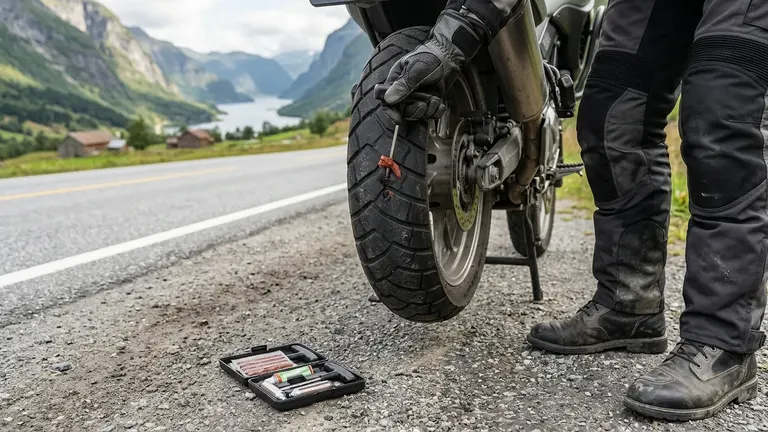
| The machine goes heavy and wanders, the steering feels loose | Front puncture | Hold the bars firmly and keep straight. No front brake; use the rear gently. Roll off gradually and stop off the carriageway. |
| The rear sways and wants to run wide in bends | Rear puncture | Hold your line. Use the front brake only, gently. No downshifts until the speed is low. |
| The front lever goes soft and pulls to the bar | The front brake has failed | Use the rear brake gently, change down and let engine braking help, and stop off the carriageway. Do not ride on. |
| The rear brake does nothing | The rear brake has failed | Brake gently on the front and let engine braking help. Expect a longer stopping distance all the way to a stop. |
| The engine revs and the throttle does not come back | A stuck throttle cable or twistgrip | Clutch in and hit the cut-off switch at once. Stop somewhere safe, and do not ride on until the fault is found. |
| A sudden loss of drive, perhaps a bang from the rear | The chain or belt has broken | Roll off, clutch in, brake gently and coast off the carriageway. Do not ride on. If the rear wheel locks, the rear-skid rule applies: once the back is out of line, hold the brake until you stop. |
| The revs climb but the speed does not | The clutch is slipping | Roll off and stop. A slipping clutch does not improve with use. |
| The clutch lever is slack and does nothing | The clutch cable has broken | You can ride on carefully to somewhere safe and change gear gently without the clutch. Before you stop, select neutral while rolling or kill the engine with the cut-off switch. |
| The engine goes flat, the sound changes, it dies | Low oil or overheating | Clutch in before the engine locks, and coast out of the carriageway. A seizing engine locks the rear wheel. |
| A smell of petrol, smoke or flames | A leak or a fire | Stop, switch off with the cut-off switch and the ignition, and move away from the machine. Call 110 if it is on fire. Do not restart it. |
Weave and wobble
A weave is a slow swaying of the rear, usually at high speed. A wobble is a rapid shaking of the bars and front wheel, often after a bump or when the front wheel goes light and lands again. Both usually have a cause: wrong tyre pressure, an unbalanced wheel, play in a wheel or head bearing, worn suspension, or load carried too high and too far back.
- Hold the bars without locking your arms. Trying to steer against it feeds the movement.
- Roll off gradually. Do not brake, and do not accelerate.
- Shift your weight slightly forward and squeeze your knees against the tank.
- Stop and find the cause. A machine that has weaved once will tend to do it again in the same speed range.
Weave: A slow swaying of the rear of the motorcycle, usually at speed. The commonest causes are low tyre pressure, bearing play, or load carried high and far back.