
Questions and answers
What do the lines on Norwegian roads mean?
A solid line (sperrelinje) must not be driven on or over, and with a yellow solid line you must not drive to the left of it either. A warning line (varsellinje) has long dashes and short gaps and may be crossed, but a yellow one means the view ahead is too short for normal overtaking.
The lines are set out in the sign regulations (skiltforskriften) § 22, each with its own number. What matters is knowing which lines you may cross and what the colour tells you.

- Solid line (1004)
- Do not crossnot to overtake and not to turn off
- Warning line (1002)
- May be crossedbut yellow means too little view to overtake
- Yellow line
- Oncoming trafficwhite is used for everything else
- Hatched area (1014)
- Keep off itwhen it is bordered by a solid line
The lines on the road and what they mean for you
| What it shows | What you do | |
|---|---|---|
| Lane line (1000) | What it shows Separates lanes | What you do May be crossed under the traffic rules |
| Warning line (1002) | What it shows Yellow: short view. White: risky lane change | What you do May be crossed, but think twice |
| Solid line (1004) | What it shows Separates lanes | What you do Do not drive on or over it |
| Combined lines (1006) | What it shows A different line on each side | What you do Follow the line nearest you |
| Edge line (1012) | What it shows Outer edge of the carriageway | What you do Keep well inside your lane |
| Hatched area (1014) | What it shows Area with a solid border | What you do Do not drive on it |
The numbers are the official codes in the sign regulations § 22.
Solid line: not on it, not over it
The sign regulations § 22 say of the solid line (sperrelinje, 1004): it must not be driven on or over, and you must not drive to the left of a yellow one. That also applies when you want to turn into a property or a side road. Between two lanes going the same way the solid line is white, and you may not change lanes there.
Lines made of raised ribs or studs count as solid (§ 21 no. 4). Two parallel solid lines no more than 100 cm apart, with the surface milled between them, count as a hatched area (sperreområde), and you must not drive on that either.
Warning line: you may cross, but take the hint
A yellow warning line (varsellinje, 1002) means the view ahead is too short for normal overtaking. A white one warns that changing lanes is risky. You may cross it, but the judgement is yours: overtaking is forbidden where a hill crest, a bend or anything else blocks the view (traffic rules § 12 no. 5).
Yellow or white
Yellow markings separate traffic going in opposite directions or make the direction of travel clear. All other markings are white (sign regulations § 21 no. 3). A yellow line on your left means oncoming traffic may be on the other side. The colour does not tell you whether you may cross. For lines between lanes, whether the line is solid or broken does.
Road lines belong to the exam theme signs and road markings. Read more in chapter 5 of the theory course, or take a free theory test.
How the theory test asks about it
TrapYou may cross a solid line to turn into a property on the left.
The ruleNo. You must not drive on or over a solid line, and there is no exception for turning off. Drive on and turn round where it is allowed.
TrapA warning line means overtaking is forbidden.
The ruleNo, a warning line may be crossed. A yellow warning line tells you the view is too short for normal overtaking, so you must judge whether you can see far enough.
TrapHalfway through overtaking you reach combined lines with the solid line nearest you, so crossing back is forbidden.
The ruleWith combined lines you follow the line nearest you. If you have already crossed into the oncoming lane, you may still return to the right-hand side.
TrapA yellow line is stricter than a white one.
The ruleColour shows direction: yellow separates oncoming traffic, white is used elsewhere. Whether you may cross a line between lanes depends on whether it is solid or broken.
Sign or line: two different bans
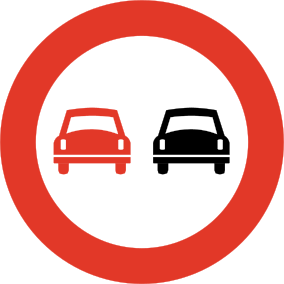
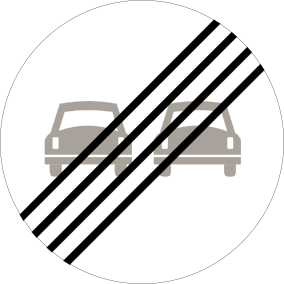
Sign 334 bans overtaking motor vehicles with more than two wheels, until sign 336 or over the distance shown on a plate below it. A solid line bans driving over the line, whatever you are passing.
Try two questions
Two questions from our question bank on road lines and overtaking.
Real practice questions with the answer and an explanation. No account needed.
Sources
- Sign regulations chapter 11 Road markings, § 21 and § 22 (1000–1014), and § 8 (signs 334 and 336) (Lovdata)
- Traffic rules § 5 (position on the road) and § 12 (overtaking) (Lovdata)
Checked against the sources 21 November 2026.
More questions and answers

Ready to pass the theory test?
A free account gives you a taste of every theme. Full access opens everything – 199 kr for a month, no auto-renewal.
Frequently asked questions
What is the difference between a solid line and a warning line?
A solid line must not be driven on or over. A warning line has long dashes and short gaps and may be crossed, but a yellow one means the view is too short for normal overtaking.
What does a white solid line mean?
It separates lanes going the same way. You must not drive over it, so you cannot change lanes where the line is solid.
What does a double yellow line in the middle of the road mean?
Two solid lines are two separate solid lines (sperrelinjer), so neither direction may cross them. A double yellow warning line, which is broken, separates lanes whose direction of travel can change.
Can I overtake across a warning line?
Yes, the line may be crossed. But overtaking is forbidden where a hill crest or bend blocks the view, and the road must be clear far enough ahead.
All questions and answers
- Questions and answers about the theory test
- How long is the theory test valid?
- How much does the theory test cost?
- Who goes first at a junction?
- Basic traffic course in Norway – how long is it?
- How many driving lessons are compulsory for class B?
- Safety course on the road – what happens on it?
- How many road sign groups are there?
- How far before the hazard is a warning sign?
- How many mistakes can you make on the theory test?
- Can you take the theory test orally?
- How do you work out stopping distance?
- What are the general speed limits in Norway?
- What are the rules in a Norwegian roundabout?
- What is the difference between stopping and parking?
- What is the difference between a motorway and a motor road?
- What are the rules for learner driving in Norway?
- How much does a class B driving licence cost in Norway?
- Home