
Questions and answers
How do you work out stopping distance?
Drop the last digit of your speed. Reaction distance is that number times your reaction time in seconds times 3. Braking distance on dry asphalt is the number times itself, divided by 2. At 80 km/h with a one-second reaction time that gives 24 + 32, so roughly 56 metres to stop.
Stopping distance is reaction distance (reaksjonslengde) plus braking distance (bremselengde). The rules of thumb here are the ones in chapter 11 of our theory course. They give rough figures for dry asphalt, and they explain what the Norwegian theory test really asks about: what happens when speed goes up or the road turns slippery.
- Reaction distance
- speed/10 × sec × 380 km/h and 1 second: 24 metres
- Braking distance, dry asphalt
- (speed/10)² ÷ 280 km/h: 32 metres
- Double the speed
- 4 × the braking distancereaction distance only doubles
- Wet or icy road
- × 2 or × 4applies to braking distance, not reaction distance
Work out the stopping distance
Stopping distance
56 m
- Reaction distance
- 24 m
- Braking distance
- 32 m
80 km/h: reaction 24 m + braking 32 m = 56 m
Dry asphalt, 1 second reaction time
| Speed | Reaction | Braking | Stopping |
|---|---|---|---|
| 30 km/h | 9 m | 4.5 m | 13.5 m |
| 40 km/h | 12 m | 8 m | 20 m |
| 50 km/h | 15 m | 12.5 m | 27.5 m |
| 60 km/h | 18 m | 18 m | 36 m |
| 70 km/h | 21 m | 24.5 m | 45.5 m |
| 80 km/h | 24 m | 32 m | 56 m |
| 90 km/h | 27 m | 40.5 m | 67.5 m |
| 100 km/h | 30 m | 50 m | 80 m |
| 110 km/h | 33 m | 60.5 m | 93.5 m |
The rule of thumb from the theory: reaction distance = (speed ÷ 10) × reaction time × 3, braking distance = (speed ÷ 10)² ÷ 2 on dry asphalt, roughly twice that on a wet road and four times on ice. These are estimates – the real car, its tyres and the road decide.
How to work it out, step by step
Take your speed in km/h and drop the last digit: 80 becomes 8. Reaction distance is that number times your reaction time in seconds times 3. An alert driver needs about one second, so at 80 km/h: 8 × 1 × 3 = 24 metres.
Braking distance on dry asphalt is the number times itself, divided by 2. 8 × 8 = 64, and 64 ÷ 2 = 32 metres. Add them up for the stopping distance: roughly 56 metres at 80 km/h. At 50 km/h it is 15 + 12.5, so about 28 metres.
Why multiply by 3 and divide by 2?
The 3 turns km/h into metres per second. 80 km/h is about 22 metres a second, and 8 × 3 = 24 is close enough. Dividing by 2 gives the braking distance on dry asphalt with normal good grip. Braking distance grows with the square of the speed, so the same rule works at any speed. For comparison, Trygg Trafikk gives 53 metres at 80 km/h on dry asphalt with a one-second reaction time.
That is why a little extra speed costs so much. The Norwegian Public Roads Administration (Statens vegvesen) works out that if you only just stop in time from 80 km/h, at 90 you would have hit the obstacle at 50 km/h.
What the theory test really checks
The key thing to know is how it fits together: what doubles, what quadruples and what the road surface affects. The rule of thumb is for dry asphalt. On a wet road the braking distance can be about twice as long, and on a slippery winter road about four times as long.
Read chapter 11 of the theory course, practise speed and positioning, or take a free theory test.
Stopping distance at 80 km/h on different surfaces
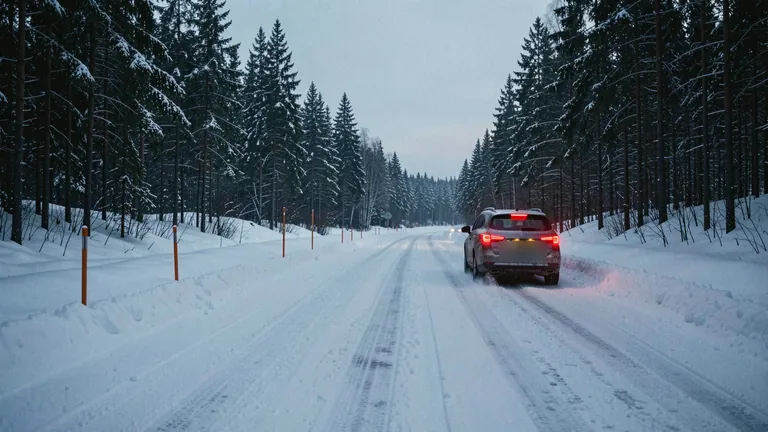
The reaction distance is 24 metres in all three. The braking distance is 32 metres on dry asphalt and roughly doubles or quadruples. Rough figures from the rule of thumb with a one-second reaction time.
How the theory test asks about it
TrapDouble your speed and your stopping distance doubles.
The ruleOnly the reaction distance doubles. The braking distance becomes about four times as long, so the stopping distance more than doubles.
TrapA slippery road makes your reaction distance longer.
The ruleThe road surface changes the braking distance. Reaction distance depends on your speed and on you. Tiredness, alcohol and phone use slow your reactions.
TrapThe question works it out exactly, or gives a different rule of thumb.
The ruleUse the figures and the rule given in the question and pick the closest option. At 90 km/h the car covers exactly 25 metres a second. The rule of thumb gives 27.
TrapThe sign says 80, so 80 km/h is fine in thick fog.
The ruleYou must be able to stop within the stretch of road you can see (traffic rules § 13 no. 1). If your stopping distance is longer than your view, you are going too fast.
Try real test questions
Three questions on reaction and braking distance, the way they can appear on the theory test.
- 1Braking distance when speed doubles from 40 to 80
- 2How far does a car travel in one second at 90 km/h?
- 3What increases a driver's reaction time the most?
Real practice questions with the answer and an explanation. No account needed.
Sources
- Traffic rules § 13 no. 1, special provisions on speed (Lovdata)
- Keep to the speed limit (Statens vegvesen, Norwegian)
- Veivalg teacher's guide, parts 1–3, p. 13: stopping-distance table (Trygg Trafikk and Norsk vegmuseum, Norwegian)
Checked against the sources 21 November 2026.
More questions and answers
Ready to pass the theory test?
A free account gives you a taste of every theme. Full access opens everything – 199 kr for a month, no auto-renewal.
Frequently asked questions
What is the difference between braking distance and stopping distance?
Braking distance runs from the moment the brakes take hold until the car stands still. Stopping distance is the whole distance from when you spot the hazard: reaction distance plus braking distance.
What is the braking distance at 50 km/h?
About 12.5 metres on dry asphalt by the rule of thumb: 5 × 5 ÷ 2. With a one-second reaction time the stopping distance is about 28 metres. On a slippery winter road the braking distance can be around 50 metres.
What is the stopping distance at 80 km/h?
About 56 metres on dry asphalt with a one-second reaction time: 24 metres of reaction distance and 32 metres of braking distance. On a slippery winter road it can be around 150 metres.
What reaction time should you assume?
About one second for a rested, alert driver. Tiredness, alcohol and phone use make it longer, and the reaction distance grows by the same amount.
Why is braking distance longer in the rain?
Water reduces the friction between tyre and road. On wet asphalt the braking distance can be about twice as long as on a dry road. Worn tyres with shallow tread make it worse.
All questions and answers
- Questions and answers about the theory test
- How long is the theory test valid?
- How much does the theory test cost?
- Who goes first at a junction?
- Basic traffic course in Norway – how long is it?
- How many driving lessons are compulsory for class B?
- Safety course on the road – what happens on it?
- How many road sign groups are there?
- How far before the hazard is a warning sign?
- How many mistakes can you make on the theory test?
- Can you take the theory test orally?
- What are the general speed limits in Norway?
- What are the rules in a Norwegian roundabout?
- What do the lines on Norwegian roads mean?
- What is the difference between stopping and parking?
- What is the difference between a motorway and a motor road?
- What are the rules for learner driving in Norway?
- How much does a class B driving licence cost in Norway?
- Home