
Questions and answers
What is the difference between a motorway and a motor road?
The traffic rules are the same on both: only motor vehicles that can legally do at least 40 km/h, no mopeds, and no stopping, reversing or turning round. The difference is the road standard. A motorway (motorveg) is built with at least two lanes each way and a central reservation with a barrier. A motor road (motortrafikkveg) falls short of motorway standard and may have oncoming traffic.
The rules are in the traffic rules § 4 no. 2, § 11 no. 2 and § 17 no. 1 (e). All three name both road types together, and they also apply on the slip roads. On our sign pages the motor road is called an expressway.
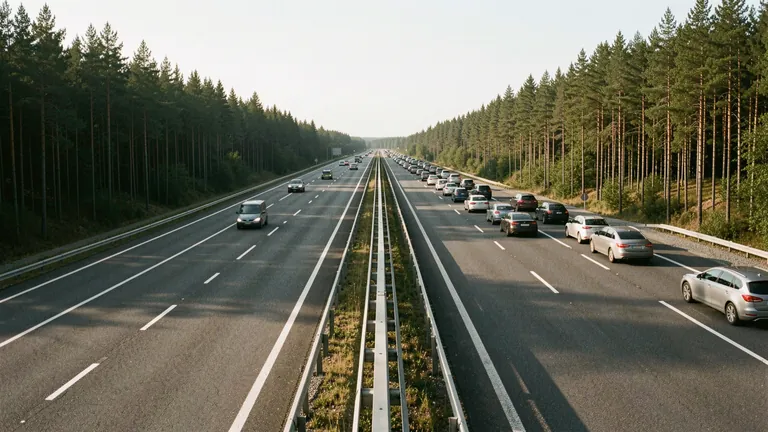
- Who may drive
- At least 40 km/hmotor vehicles that can legally do that on a level road
- Mopeds, pedestrians, cyclists
- Bannedonly motor vehicles are allowed
- Stopping
- Bannedon the slip roads too
- Reversing and turning round
- Bannedon the slip roads too
Motorway and motor road side by side
| Motorway | Motor road | |
|---|---|---|
| Sign | Motorway 502 Motorway | Motor road 503 Motor road |
| Design | Motorway Two or more lanes each way, central barrier | Motor road Below motorway standard, may have oncoming traffic |
| Which vehicles | Motorway Motor vehicles that can legally do 40 km/h | Motor road The same |
| Mopeds, pedestrians, cyclists | Motorway Banned | Motor road Banned |
| Stopping | Motorway Banned | Motor road Banned |
| Reversing and turning round | Motorway Banned | Motor road Banned |
| Speed limit | Motorway Whatever the sign says | Motor road Whatever the sign says |
The rules apply from the sign to the end sign (504 or 505), to the sign for the other road type, or to the junction where the exit road meets an ordinary road.
What the law says about both
The traffic rules § 4 no. 2 say that on a motorway or motor road, and on their slip roads, the only traffic allowed is motor vehicles or vehicle combinations that can legally do at least 40 km/h on a level road. Mopeds are named separately and must not be ridden on a motorway or motor road. Since only motor vehicles are allowed, pedestrians and cyclists are not either.
§ 11 no. 2 bans reversing and turning round, and § 17 no. 1 (e) bans all stopping. Both bans apply on motorways, on motor roads and on their slip roads.
The difference is the road
The Norwegian Public Roads Administration's design handbook N100 describes a motorway as a road with no driveways to the properties along it. It is built with four lanes, a central reservation with a barrier and grade-separated junctions. A motor road falls short of motorway standard, but it also has no direct driveways to properties. It can be a two-lane road with oncoming traffic.
The speed limit is on the sign
Neither road type has a speed limit of its own. With no sign, the limit outside built-up areas (tettbygd strøk) is 80 km/h (Road Traffic Act § 6). The Directorate of Public Roads can set a higher limit for a stretch (road sign regulations § 26). Official speed-limit criteria go up to 110 km/h, which is for four-lane motorways. 40 km/h is not a minimum speed you must hold. It is a requirement on what the vehicle can legally do.
Read more in chapter 14 of the theory course, practise speed and positioning, or take a free theory test.
How the theory test asks about it
TrapThe motor road has only one lane each way, so ordinary rules apply there.
The ruleNo. Sign 503 brings the same rules as a motorway: no mopeds, no stopping, no reversing or turning round.
TrapYou missed your exit. Can you reverse back along the hard shoulder?
The ruleNo. Reversing and turning round are banned on motorways, motor roads and their slip roads (§ 11 no. 2). Drive on to the next exit.
TrapThe road is signed 100 km/h and you are towing a trailer.
The ruleWhere the limit is above 80 km/h, a car with a trailer may do at most 80 km/h. The exception is when both car and trailer are approved for 100 km/h (§ 13 no. 4).
TrapCars on the motorway must let you in from the slip road.
The ruleYou are changing lanes, so you give way (§ 8 no. 1). Match your speed and join when it is clear. Drivers already on the motorway should make it easy for you to get in (§ 8 no. 2).
The signs for motorways and motor roads
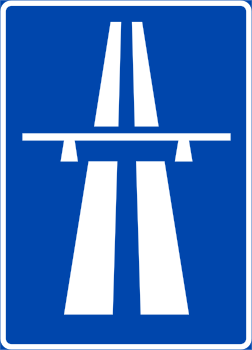
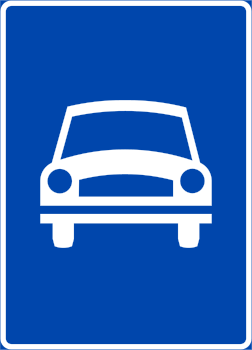
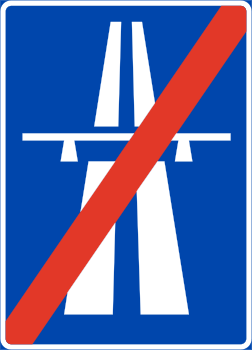
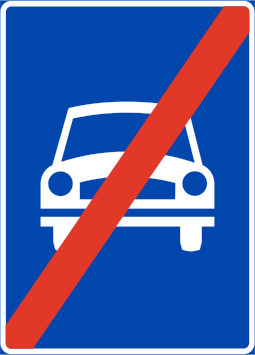
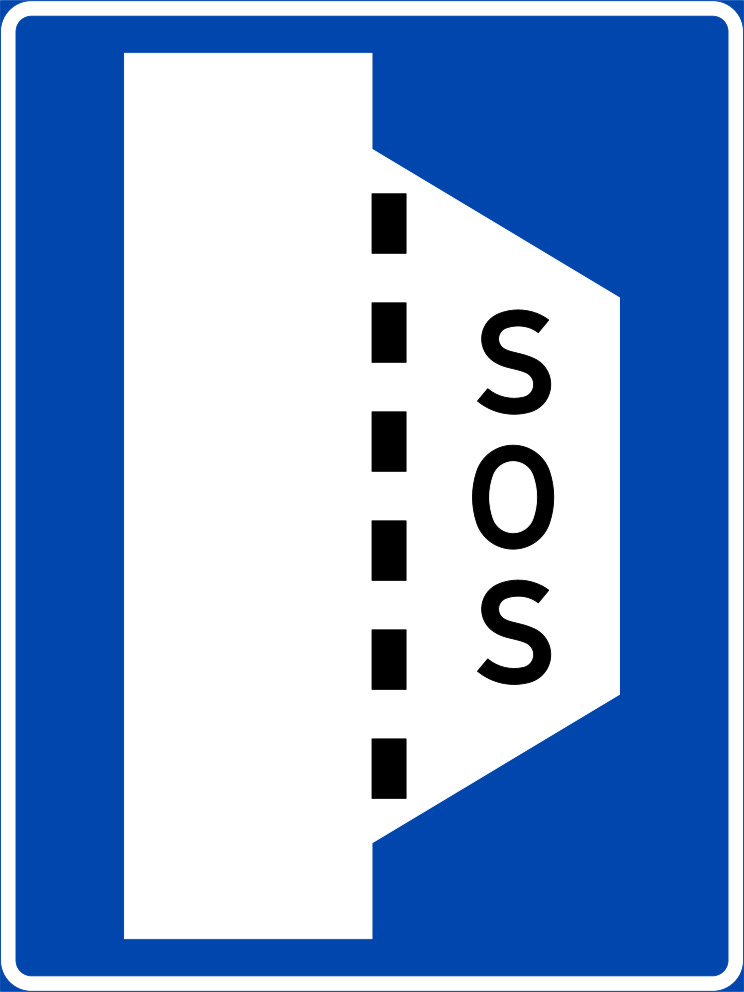
After 504 or 505 the ordinary traffic rules apply again. The emergency stopping bay (555) is marked along the road.
Practise motorway questions
Two questions of the kind you will meet on the theory test: your speed with a trailer, and who gives way when you change lanes.
Real practice questions with the answer and an explanation. No account needed.
Sources
- Traffic rules § 4 no. 2, § 8, § 11 no. 2, § 13 no. 4 and § 17 no. 1 (e) (Lovdata)
- Road sign regulations § 12 (signs 502–505) and § 26 (speed limits) (Lovdata)
- Road Traffic Act § 6 (speed rules) (Lovdata)
- Norwegian Public Roads Administration, handbook N100 Road and street design (definitions and design classes)
- Norwegian Public Roads Administration: giving way in different situations (acceleration lane)
- Norwegian Public Roads Administration: speed-limit criteria circular 2021/01 (30–110 km/h)
Checked against the sources 21 November 2026.
More questions and answers
Ready to pass the theory test?
A free account gives you a taste of every theme. Full access opens everything – 199 kr for a month, no auto-renewal.
Frequently asked questions
Can you ride a moped on a Norwegian motor road?
No. The traffic rules § 4 no. 2 say mopeds must not be ridden on a motorway or motor road.
What is the speed limit on a motor road?
Whatever the sign says. The road type has no limit of its own. With no sign, the general limit of 80 km/h outside built-up areas applies.
Is there a minimum speed on a Norwegian motorway?
No, there is no fixed minimum speed. The rule is that the vehicle must be able to legally do at least 40 km/h on a level road. You must still adjust your speed so other traffic is held up as little as possible.
Where do the motorway rules end?
At sign 504 or 505, at the sign for the other road type, or at the junction where the exit road meets a road that is neither a motorway nor a motor road.
All questions and answers
- Questions and answers about the theory test
- How long is the theory test valid?
- How much does the theory test cost?
- Who goes first at a junction?
- Basic traffic course in Norway – how long is it?
- How many driving lessons are compulsory for class B?
- Safety course on the road – what happens on it?
- How many road sign groups are there?
- How far before the hazard is a warning sign?
- How many mistakes can you make on the theory test?
- Can you take the theory test orally?
- How do you work out stopping distance?
- What are the general speed limits in Norway?
- What are the rules in a Norwegian roundabout?
- What do the lines on Norwegian roads mean?
- What is the difference between stopping and parking?
- What are the rules for learner driving in Norway?
- How much does a class B driving licence cost in Norway?
- Home