
Questions and answers
Who goes first at a junction?
At a junction with no signs, lights or other control, whoever comes from the right goes first. You must give way to vehicles coming from your right.
This is the right-hand rule (høyreregelen), in the traffic rules § 7 no. 2. It only applies when nothing else controls the junction – and the exceptions are what people get wrong.
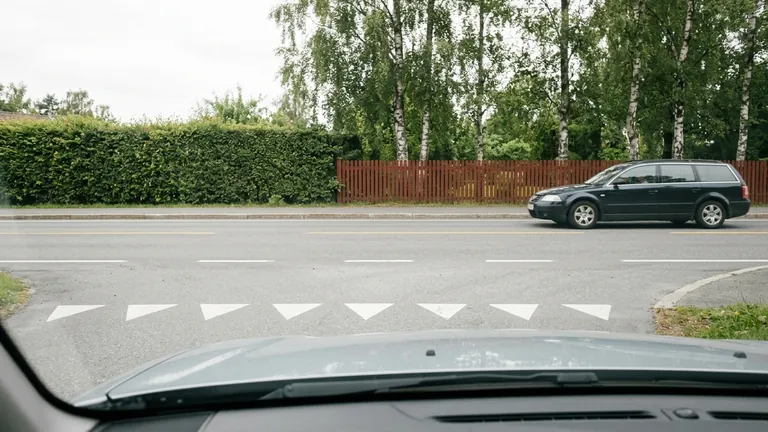
- Main rule
- The right-hand rulegive way to vehicles from the right
- Turning left
- Same rulegive way to whoever then comes on your right
- When turning
- Give way to pedestriansand cyclists going straight on
- From a car park or property
- You give wayto all other traffic
The right-hand rule at a junction
The right-hand rule, word for word
Traffic rules § 7 no. 2: drivers must give way to vehicles coming from the right. The same applies when a driver turning left will have vehicles on their right side. That last part means that when you turn left, you also give way to oncoming traffic going straight on or turning right – it comes in on your right.
Cyclists on the carriageway count as drivers. A cyclist coming from the right at an uncontrolled junction therefore has priority under the right-hand rule.
What overrides the rule
- Give-way and stop signs: you give way to traffic on the road you are entering, from both sides.
- Priority road: on it, traffic from the side roads must give way to you.
- The exit rule (§ 7 no. 4): coming from a car park, property, petrol station, pedestrian street, home zone, farm track, pavement or cycle path, you must give way – to traffic from the left as well.
- The turning rule (§ 7 no. 3): when you turn, you give way to pedestrians, cyclists and riders of small electric vehicles going straight on.
Giving way means showing it early
§ 7 no. 1 says that whoever must give way shall show it clearly by slowing down or stopping in good time. Doing it at the last moment is not enough – the other road user should never have to wonder whether you will stop.
On the theory test the question is almost always the exception: a side road that looks like a junction but is an exit, or a sign that cancels the right-hand rule. Practise right of way or take a free theory test to see if you spot them.
How to work out who goes first
- 1Are the police directing traffic?Then follow their signals, whatever the lights and signs say.
- 2Are there working traffic lights?Then the lights decide. Turning on green, you still give way to pedestrians and cyclists going straight on.
- 3Are there signs?A give-way sign, a stop sign or a priority road overrides the right-hand rule.
- 4Are you coming out of an exit?From a car park, property, petrol station, pedestrian street, home zone, pavement or cycle path, you give way to other traffic.
- 5None of these?Then the right-hand rule applies: give way to whoever comes from the right.
Sources
Checked against the sources 4 October 2026.
More questions and answers
Ready to pass the theory test?
A free account gives you a taste of every theme. Full access opens everything – 299 kr for a month, no auto-renewal.
Frequently asked questions
Does the right-hand rule apply in roundabouts?
Rarely in practice. Roundabouts are normally signed with give-way signs, and then you give way to traffic already in the roundabout.
What if four cars arrive at once?
Then everyone has someone on their right, and the rule alone cannot settle it. Drivers must cooperate: one signals clearly and goes carefully, and nobody forces their way through.
Does a cyclist from the right have priority?
Yes, if the cyclist is on the carriageway at an uncontrolled junction. A cyclist coming off a cycle path or pavement must give way.
All questions and answers
- Questions and answers about the theory test
- How long is the theory test valid?
- How much does the theory test cost?
- How long is the basic traffic course?
- How many driving lessons are compulsory for class B?
- Safety course on the road – what happens on it?
- How many road sign groups are there?
- How far before the hazard is a warning sign?
- Home